March 24, 2007

scroll to the bottom of this page to begin the adventure when i began

(i arrive in Bangkok after the first few entries)


Need Mail bonding?
Go to the Yahoo! Mail Q&A for great tips from Yahoo! Answers users.

March 21, 2007

Power to the Peaceful -- Portland Style!

Faces of Peace: The Soul of Portland
Photographs from the new peace movement.

Dear friends of past and present,
I wanted to share some of my new photographs with you. These are some of my favorites from an incredible peace march that happened this last Sunday here in Portland, Oregon. I had a wonderful time making them and I felt really inspired by the whole event. An estimated 13,000 people showed up to add their voices and their presence. I felt particularly hopeful because of all of the young people that were there. For many, it was the first time they had participated in a rally for peace.

I wanted to create a document about this time that we live in. As the future unfolds and the years roll on, I hope that these images will become even more meaningful in that they will have recorded something important and will have provided some insight as to what things were like in this time of our lives. Made on Sunday, March 18th 2007.

The slide show is about ten minutes long. There's audio so if you want it, turn it on. It may take a minute or two to load depending on how fast your connection is. Please be patient and you will be glad for it.
Enjoy!
-raku

Please pass this on to anyone in your communities who might also enjoy it.
http://www.rakuloren.com/portland/peaceprotest_march07.htm

Stay tuned-in to www.rakuloren.com over the next month. There will be some important revisions and some beautiful additions from my travels over the past year. I spent time in Bangladesh, Nepal, India, and Cambodia. You won't want to miss that!
Blessings.


Raku Loren

Photographer | Designer | Teacher
www.rakuloren.com
503.290-6655 (cell)


8:00? 8:25? 8:40? Find a flick in no time
with theYahoo! Search movie showtime shortcut.

February 10, 2007

February Exhibit | Portland


June 01, 2006

Photography Exhibit

Know anyone in Portland, Oregon?
Hope you can visit!
-Raku

May 19, 2006

Portraits of a River

[this introduction is for a selection of photographs that I am preparing for exhibit]
Portraits of a River
From the Mountains to the Sea: Travels Along a Sacred River in Northern India


A river is much more than a thing. It is a system, a network, a web of interconnected life-ways. In a sense, a river is a living entity. It often provides both physical and spiritual sustenance to those who interact with it. The Ganga (Ghan-Ga), or Ganges as it is more popularly known as in the west, is just such a river. If one combines both the numbers of peoples that benefit from the river with its religious and spiritual significance, it could be argued that it may be the most important river in the world.

Most Hindus refer to the river by the endearing and more appropriate name, Ganga-Ma, “Mother Ganges” out of respect for this river entity. This waterway feeds hundreds of millions of peoples, from the high Himalayan mountains to the Bay of Bengal off of Bangladesh and it serves as one of the most important temples for the more than 800 million Hindus of South Asia.

The Ganges, like so many other major river systems is much more than one line, one body of water. Its tributaries and offshoots are the appendages that allow hundreds of villages to provide for themselves and to cultivate their own futures. But perhaps more than other waterways, Ganga-Ma is a sacred river, revered for thousands of years for its cleansing, healing, and rejuvanative properties.

Each time I have visited or traveled along this river, I have felt compelled to watch and perhaps learn something about the capacity for a human to connect with a supposedly non-living entity. Watching, I feel inspired by the relationship that people have cultivated with the river. I am struck by the devotion and respect that a person can have for this “thing.”

A river doesn’t end at its banks. Its influence permeates throughout the peoples and communities that sustain themselves along its shores. Thus, to photograph a river, sometimes one must look away from the water. I hope that these images speak with reverence for the river and also say something about the places that have built relationships with it.

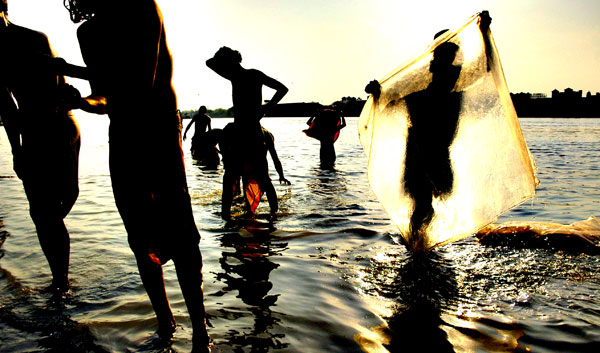
The headwaters of the Ganges begin near a place called Gaumukh in the Indian Himalaya. In this place, the river emerges from beneath a massive dirty blue glacier. Large boulders of ice tumble along in the new river currents and pilgrims, some of whom have walked for hundreds of miles (some barefoot) to get here, submerge themselves in the ice water as a sign of their devotion to the river and the Hindu gods that are associated with it.

The masses of India’s devotees make their pilgrimages to places along the river in the northern plains after it has come from the less accessible mountainous regions. Although, most Hindus hope that at least once in their lifetimes, they will be able to visit Gaumukh, the source of the great Ganges river.

It is believed that a dip in the Ganges washes away one’s past misdeeds, cleaning the slate, thus providing an opportunity to start afresh on their creator’s scorecard.

Varanasi is perhaps the most well known city along the Ganges. Individuals and families from all over the country come to bathe in its waters here. And in the itineraries of tourists coming to India, Varanasi is about as essential as the Taj Mahal. I might suggest that while the Taj Mahal is as beautiful as any other palace in the world, the Ganges is a more meaningful symbol of India and its peoples because it is a living history. It is just as relevant today as it was two thousand years ago. However, in both of these places, the curious tourist must still actively search out meaning and feeling so as to dive a little deeper into the wonderful mystery that these energy centers offer.

I remember sitting in the old city of Varanasi and along the banks of the Ganges there feeling the history of thousands of years of pilgrimage to this place, and perhaps to some of these same places along the river! And this feeling is something that we rarely if ever feel here, in this relatively new country.


It is believed that to die in Varanasi, one is released from the painful cycle of being reborn as a human and having to continue to work things out with one’s karma. So obviously a lot of people come here to bathe and in the last stages of their lives, to die. And they have been doing this for thousands of years -- with this same conviction. And so there is a texture in the air, in the smell, in the constant activity along the river’s edge night and day that makes this place a center of life and a center of death, both simultaneously.

But in India, when one has finally accepted the dirt and decay, one begins to become present to the place in its modern timelessness.
And eventually down to the ocean where the river meets the sea, where water merges into water and with the sun’s help, a meeting with the high mountain passes comes again in the form of falling snow. It melts and carries with it rock and mineral, nutritious silts to the farmer and becomes an entity for worship for millions.

And this cycling of water, over and over, from tropic to arctic and the amazing journey back down amazes me every time I think about it. The journey cultivates the lives of many beings, relationships are nourished, life propagates and then the water meets the sea – for a few moments.

The river means many things to many people. For me, it is the web that connects an enormous amount of history to our modern world. And this continues to fascinate me. It has provided me an opportunity to explore the unknown and to look a little more closely at a different kind of relationship, one between people and rivers. It has catalyzed my enthusiasm to look closely at the importance of rivers within the fabric of a cultural landscape in addition to the more practical and utilitarian ones.

These images, I hope, will be the beginning of a much larger project on rivers and people. How are rivers changing because of a growing human population? How in turn are these changes changing the peoples who have had relationships with these waterways for many generations? Considering that most of the world’s peoples depend on rivers to sustain their own existence, these questions seem to take on more meaning.


Thank you for taking the time.

May 05, 2006

On the Way Out


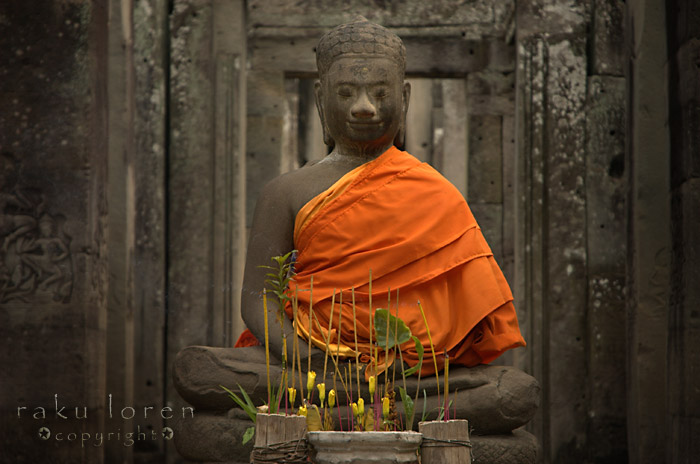
A Buddha statue at an entrance to an acient temple in northern Cambodia.

She had to move up to my seat because a couple just got on and they wanted to sit together, maybe to support each other on what all of us had read in our various guidebooks, was to be one of the worst main roads in Asia. We were on our way out of Cambodia, back to Thailand.
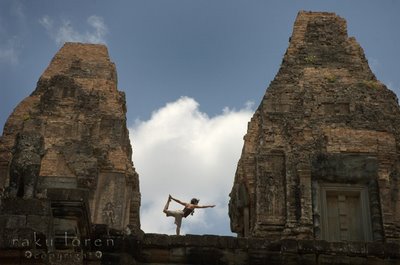
Divine inspiring divine at a temple in northern Cambodia.

The temperature was to get into the upper nineties today and our minibus had no air conditioning – of course as it was supposed to. We all paid extra for the tourist bus thinking it would be more comfortable than less expensive options. Everywhere that sold tickets said, “Yeah, air conditioning, this is the picture of your bus.” They would point to a color photography of a shiny new luxury bus. When one has traveled in Asia long enough, promises like these are far from legally binding. We just had no idea the bus would be as bad as it was. Some people wanted their money back after seeing it.
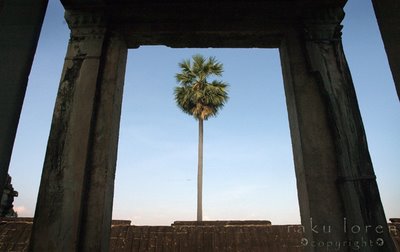
But there was nothing we could do unless we wanted to march back to a guesthouse with all of our stuff and wait to see how the bus tomorrow looked. When I saw the outside of the bus – I knew – a working air conditioning system was going to be highly unlikely on this thing and that it appeared that the bus needed so many other repairs that air conditioning had a yeah right kind of importance to it. Maybe it was because when it got closer and pulled up to where we are waiting, with open windows, that was the big clue. It’s weight without any passengers was already heavy on one side, the entire body was scratched and dented, and it looked like it had been pretty much entirely hammered out from fender (and door and side) benders. It looked like it had been driven around the world -- several times. It looked like they had imported it in from Afghanistan. Had it been rolled? I was looking to the roof, looking for any big dents before I made my final decision to get on or not. Nothing screamed out at me – just an unplaced, nearly inaudible hiss. I relegated that do the radiator and climbed on.

She moved up to my seat and that’s where we met. We didn’t formally introduce ourselves and while we talked and talked, I think, with the more time that went by, we both felt a little silly asking, “Umm, what’s your name anyway?!”
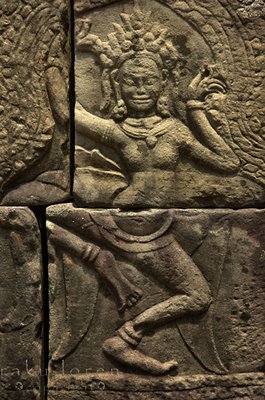
Stone blocks, temple wall, northern Cambodia.

The first half hour of the drive was pretty good. I was wondering if the guidebook was wrong on yet another fact. Then, WHAM! The pavement stopped and dirt moguls began. Our driver was taking them like he was on a slalom course. After an hour of this madness, looking around, through a cloud of red dust, seeing people holding whatever material they could find, bunched up over their mouth and nose. A few were holding their hands over their mouths. I chuckled, After an hour of this madness, looking around, through a cloud of red dust, seeing people holding whatever material they could find, bunched up over their mouth and nose. A few were holding their hands over their mouths. I chuckled, yeah, that’s gonna filter everything out! A few others were bent over. I wasn’t looking for details. We were all bouncing off our seats as we hit the bumps.
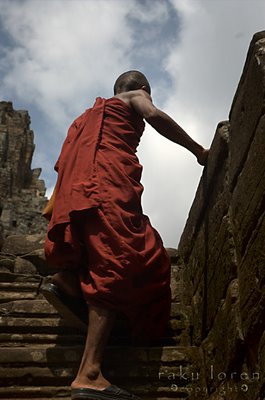
A monk climbs the steps into a temple, northern Cambodia.

The windows were rattling hard. They were self-opening with the vibration. The noise from the shaking of glass and metal was like being at a rock concert – except it was one long drum solo. Red dust from dirty clay road streamed into the bus constantly, kicked-up from the trucks in front of us. On the one hand, we all despised the dust and would have just kept windows closed but it was so stifling hot in that little oven-on-wheels that we kept the windows a little open, thus suffering from both hardships because all of one would have been probably worse.
I made the mistake that morning of putting on a clean white shirt. It was now quickly turning red especially on the window side and where I was perspiring –everywhere—the shirt was red and wet and I knew this was the end of this shirt, that it would never look clean again.
I turned to her with a smile that said, can you believe this? She shook her head and said, “Yeah, and there’s supposed to be two more hours of the same!” In that moment, I dropped whatever was covering my airways and let my jaw slacken down so it was near resting in my lap. “No way!” “Well, that’s what the book says.” We both scrunched our brows up and resumed the one hand on the dust mask, the other hand on the seat in front of us position.
Through hardship we found communion. And so for the next ten hours, we traveled together, still, we didn’t know each other’s names.
We got into Bangkok and were walking down the street together when I stopped her and said, “We’ve been traveling for ten hours together, from one country to another, on one amazingly bad road and now we’re going to share a room for a few nights -- umm, what’s your name anyway?” We had a good laugh about this.
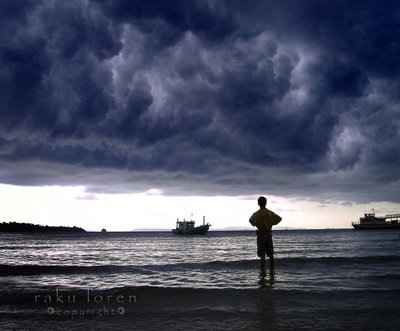
Moments before the rain began to fall, the storm rolling in was spectacular, southern Cambodia.

It’s like that when you’re traveling. You’re always meeting people, talking to people. Often, names go into one ear and out the other. Interactions are often so fleeting – and you never know how long you will know that person – that names often come later. In this case, a lot later!
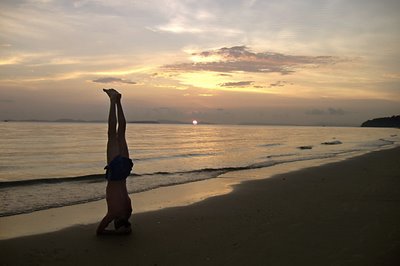


My yoga meditation, sunset, southern Cambodia.

April 28, 2006

Sun Rain

When I awoke this morning, it was late already. My head felt heavy from a late night of reading – a smart thriller that I couldn’t put down. I emerged from the cocoon of my mosquito net fortress-in-shambles and ambled over to the window. The sounds and energy of the traffic from the street below indicated that the day was somehow different. I grasped the bars over the window and flicked the wooden blinds open with the tips of my fingers. Sunlight poured in and I felt both a welcoming relief and a bit aghast at the unaccustomed brightness of the outside world. This was the first real sun in several days of cold, rainy, monsoon wetness. Holding onto the bars, I sank back, stretching my arms and torso long, opening my lungs up, I took some long deep breaths in and blew out all of the sleepy stagnancy that I was still holding onto.

I had left the bomb blasts of Bangladesh and come into the cyclones of Chennai. In two days I skirted India’s eastern coast by train. Chennai is a coastal city in the country’s southernmost state, Tamil Nadu. Somehow, I had forgotten about the other monsoon that India gets. The south gets a summer monsoon that comes from the south-west and a winter one which comes from the north-east. I wasn’t mentally or materially prepared at all for the torrential drenching I would encounter, the streets that would become rivers in a matter of minutes, the problems associated with getting from one place to another or just trying to dry my laundry.

But all of this is part of the rhythm of this place. For ages, this is the wind that has blown. And so the people have also adapted to this. The farmers who grow rice in the country and the housewives who always have an eye to the sky so they can rescue the clothes drying on the line up on the roof. During these monsoons, blue sky and bright sun can become dark brooding clouds in a few minutes. When this happens, one has only a few minutes to strategize their next move. The sky changes, the winds kick-up in swirling gusts, the air becomes charged and the crows start making a run for cover.


I had just gotten a couple of books from a shop just down the street from my hotel. The shop keeper had brought out a couple more that he thought I might like and I was perusing when I looked over my shoulder – I felt a new presence. It was water pouring from the sky in such force it was bouncing off the ground and raining upwards again. In such a circumstance, I normally would just cozy-in somewhere undercover, wait it off, hold onto a warm glass of chai. But I remembered something that was going to disrupt any idea I had of staying dry.


On seeing the sun this morning, laundry became a focal point of the day’s activities – one never knows when the next offering of dry, warm sky will be. And so with many other like-minded folks on rooftops far and wide, we hung our pants, shirts, socks, and saris. In two moments, I thanked the bookseller, rubbed my fists together and pointed up to the top of the building and then to the rain coming down. He understood and in two steps, I was on the sidewalk taking a half-moment to psyche up for the mad dash back to my hotel.

Street vendors were frantically pulling tarps out to blanket over piles of their books, fruits, clothes, and wares. All around me people were scurrying about. Everyone was running for cover with either a fearful grimace that contorted their faces or with one which seemingly recognized the cosmic joke that all of this was. I thought of the scene just outside of an ant hole in the garden after the sprinklers come on. That’s us right now!

I leaped off the curb and made the forty yard dash to my hotel. In these first few moments that the rain falls, people are frantic to stay dry. It’s the kind of rain that is so thick, it can soak you in no time at all. Everyone is running, hunched over, holding whatever object is convenient over their heads, high-stepping to keep the sandals on their feet on. On my way, I am dodging and spinning around parked rickshaws and possible tackles from people on moving scooters who are also scurrying – at high speed – and whose only vision is from the squint in their eyes, the scrunched faces apparently keeping them somewhat drier than a relaxed face. I am also trying to keep my sandals on.

I arrive at my guest house and am sprinting up five flights of stairs to the rooftop where my nearly dry clothes are no longer nearly dry. The rain is crashing down and I am trying to expediently untie my clothes from the lines. Now I am the one squinting, rain streaking down my forehead to my brow. I collect everything, pack it under my arm and dash back in for cover. I’ve made it.

Then I look down at the clothes I am wearing; I wonder what clothes I was trying to save from getting wet! The absurdity of all of this – Ha!
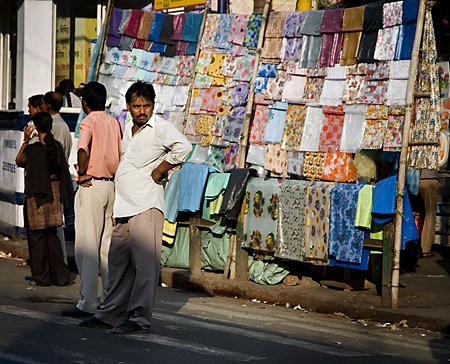
More signs that make me wonder...

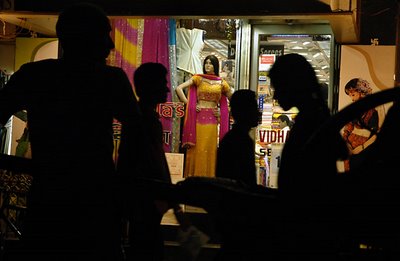
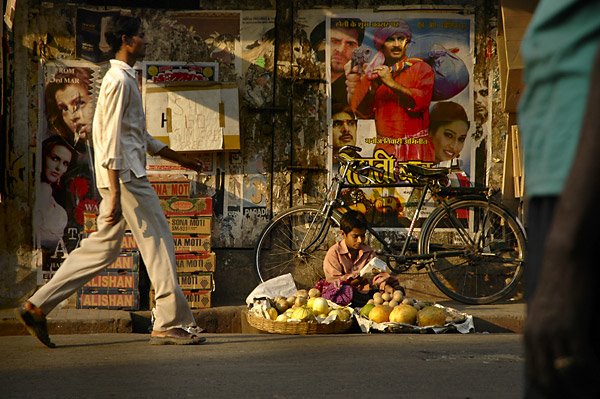
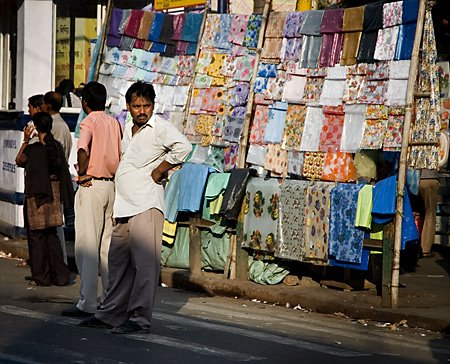
A man waits for a bus in the late afternoon sun next to a street stand displaying various fabrics.

From a Bengali movie poster. Are those women running out of the surf carrying machine guns?!


From a Calcutta Metro Do and Don’t list inside the train car, along with where to stand and directions on what to do in case of emergency:
“Please avoid listening to and spreading rumors.”
and another,

“Metro cares for you. Please do not get panicky.”
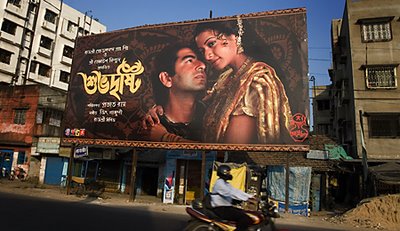

street billboard


“100% virgin plastic.”
From a big round sticker on a plastic bucket outside of a chai stall near my hotel that I go to in the mornings.
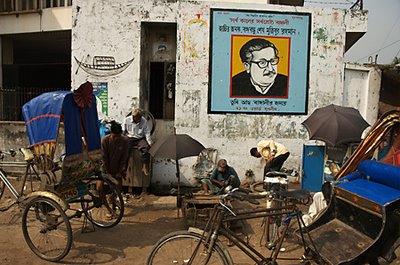

Political sign painted on the outside of someone's house. Rickshaws parked out in front. Notice the drawing of the traditional style boat near the door way.
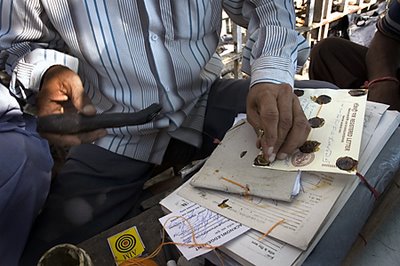

Outside of post offices, there are people selling envelopes and pens, those who will wrap a parcel with the obligatory cotton fabric and than stitch it together with needle and thread, there are notaries, there are men with type writers on little wooden tables who can make something look official or transcribe something into Hindi or English but mostly to write for those who never learned how, there are others like this man who will seal the seams of a letter or a parcel with wax stamps to ensure it arrives untampered with.

and

Lung Fung
The name of a Chinese restaurant that I am pretty sure I don’t want to eat at!
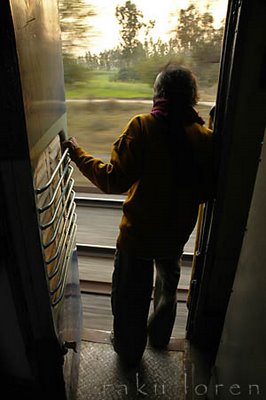
April 27, 2006

Snapshots From a Train

A white cow with sharp, in-curled horns
Lays in the grass
Next to a white egret
who is ankle deep in a small pond of water.

Long stalks of dry grasses bunched together
Stacked on their ends
Leaning inwards, forming small teepees
Under the sun.

A dozen railcars, cargo cars, stopped
On the nearby tracks
Chest high piles of broken coal beside them.
Young men, their skin and clothing black from the dust
Shoveling
Heap after heap
From one pile to another.
A grey cloud over their heads, the black dust everywhere
Inside and out.

Three small boys stand next to field of sugarcane.
They watch our train passing by.
They all have big smiles on their faces.
They are waving to everyone and no one.
But they are sincere and so I struggle
to quickly push my hand out the window,
hoping that just one of them sees
my hand waving back.

There is a white haze
maybe an early evening fog
that has settled over the fields.
Trees in the distance fade into silver and then into the color of the colorless sky.

Fields of bright yellow mustard swim in the wind
Pools in a vast sea of vibrant green grass.

Patties of cow dung and bits of broken straw
Pressed firm with the print of a woman’s hand.
Clusters under the sun
They blanket the ground, drying.
Some are balanced against each other, both standing on an edge,
hoping to catch a little more of the low sun.
Dry discs are neatly organized in ascending round piles.

Women carrying loads
Balanced atop their heads
In the fading light of a periwinkle sky.
A bundle of laundry
Branches for kindling or for some fence
A sheet wrapped sack
Full with green leaves for the animals.
Some carry clay pots of water from a nearby well.

Men on bicycles riding along a narrow
desolate road
On their ways to places I can not see on the horizon.

In looking through many images
And remembering ones I have made in the past
that I don’t seem to tire of,
I am seeing my own experiences of being here,
of traveling and existing.
And they are in the eyes, faces, and non-verbal gestures of the subjects
whom I find drawn to make photographs of.

I am seeing more clearly that I have been looking at pieces of myself, of my being, of my experience. Many of these images are the reflections of the glimpses I have had of my own looking-in and the struggles of my own existence here and at home – everywhere that is.


Holi and the White Man

The origin of the Holi celebration comes from a mythic story which is really quite beautiful. Following one of the standard Hindi Bollywood masala films that are a staple and a mainstay in modern Indian life (see A Night at the Movies) but actually predating and probably being the primary influence on Indian film itself, the perennial favorite of the Hindu deities, Krishna, falls for this girl named Radha but of course, there was one problem, his skin was much darker than hers and this caused him much angst.

He went to his mom and voiced his frustrations. His mother said, “Look, take this colored powder and joyfully toss this on each other. Then see that there are no differences.” Of course, she was saying that this difference of skin color was a minor, if not superficial, indication of one’s person. It is beneath this where the importance of our beings dance. That is what we should be striving to see and to experience.


And so on this day of festivities, most of Hindu India celebrate in one of their favorite festivals; it’s called Holi. I pretty much new what to expect around the tourist ghettos: all of the workers in the area that had to serve the jerks and air heads from the last twelve months finally had license to let off some steam with probable group ambushes using special force like choreography all in the name of a little fun and celebration – yeah right, that will be a lot of fun. I knew it would not be fun for everyone for very long so I decided well in advance that I would be somewhere else on that particular day.

I asked several people where they thought I should go for Holi. “Where will people really be celebrating in a very Indian way?” is what I would ask. A village several hours away called Shantiniketan kept coming up. Besides several hours of travel, I would have to leave several hours earlier than I normally wakeup to ensure that I arrive for the climax of the festivities, in the morning. But because the name of this village kept coming up, I thought it must be a sign; the same recommendation from all of these people, I must go. And so I did.

Not long after my arrival there, I realized that the fear I had had of being at the center of a lot of unwanted attention wasn’t just some unfounded fiction and it wouldn’t be quite so easy to dodge. It was real and it would prove to manifest itself in a variety of forms. Here, it wasn’t just what the lightness of my skin color represented, I attracted an excessive amount of attention because I was one of the few non-Indians there, in this little village, I really stood out and so people would stop what they were doing – and I would see this over and over, turn towards me as they elbowed their friends around them and then begin to converge on me like walking Frankensteins . I felt like I was in some strange Indian zombie movie. Attack of the jolly Hindus!
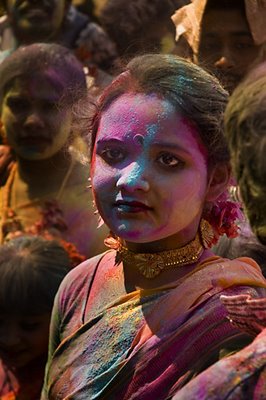
People from all around had made a pilgrimage to this village famous for it’s University named after the beloved renaissance poet/writer/playwright/musician Rabindranath Tagore. There seemed to be plenty of merriment all around even with the traffic of rickshaws taking people to and from the campus that had open-air classrooms and many large shady trees.
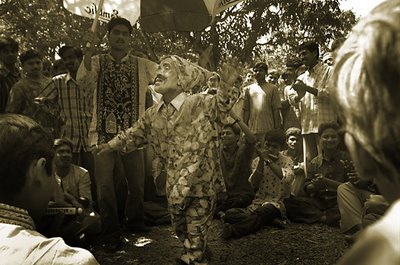

Yes, everyone seemed to be celebrating with playful vigor but my presence convinced me that I must have something that resembled a small disco ball attached to the top of my head. My being there caused heads to turn and feet to move – towards me – with clenched fists full of powdered dyes of radiant hues. There was always the convivial wide, full tooth smile and the “Holi hai!” or “Happy holi!” After a while, my first mental reflex was the second of a three part experience. Just after their eyes met mine and the switch of my seemingly electromagnetic pull turned on, I would think, “Yeah right! Here we go – again.”
One would begin by politely smearing a colorful powdered dye on my forehead, cheeks, and anywhere else on my face that hadn’t already been tagged. Then I would feel the tumbling drizzle of powder falling down my back, between my white shirt and my sweating skin. Everyone had to have their turn with me. Each with an overly-enthusiastic smile, and the happy holi! bullshit. The smearing and then the avalanche of unnaturally bright synthetic dyes cascading down from the top of my head to my feet, dusting my skin and finding small creeks of perspiration to coalesce into. My hair became a dry mat conglomerate of the six or seven most popular colors. My skin would have to be vigorously scrubbed in the shower for many days after. And my clothes, well, they would never look the way they once did. That I knew from the first minutes after my arrival.
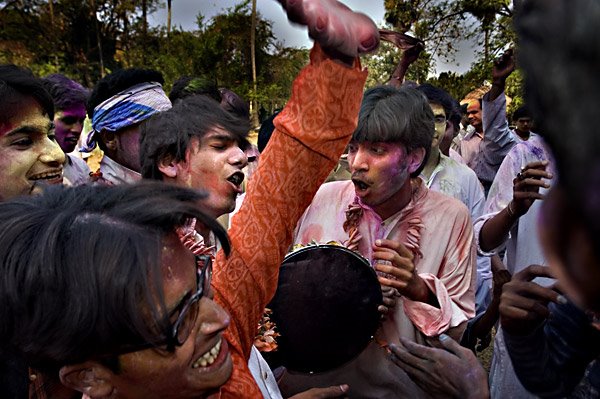
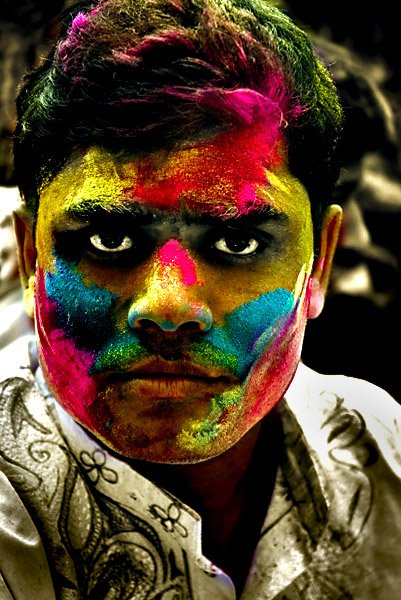
For this white man, Holi was fun for about the first three minutes but then became redundant with the tiring thrill of “Hey, there’s a tourist! Let’s get him and than ask him some boring questions that he must hear 30 times a day!” of course what I thought would be a jackpot of photographic opportunity became a challenging (and frightening) experience due to all of the powdered dyes flying around and the cheeky Indians who thought they were clever to sneak up on me and surprise me with a billowing cloud of yellow powdered dye thrown over my head. Yeah, another original idea – let’s ambush the tourist! But here are a few images I thought you might enjoy. I made them when my camera wasn’t hiding in a zip-lock bag, tucked in the pit of my arm.
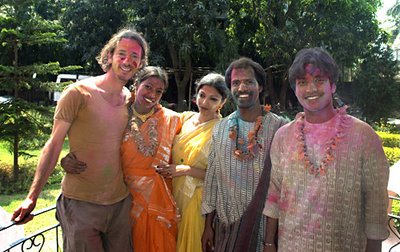
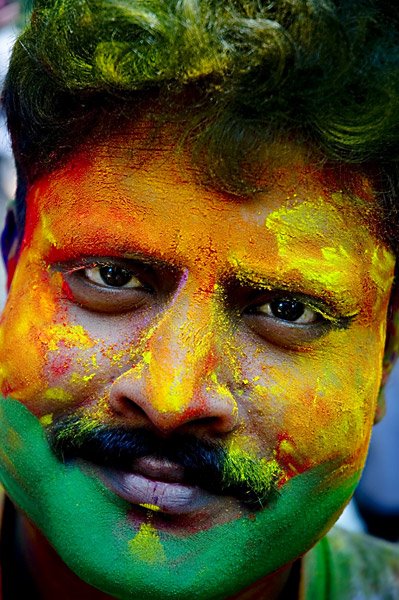
I met and became friends with these great people, amazing dancers. I am wearing what was once a white shirt.

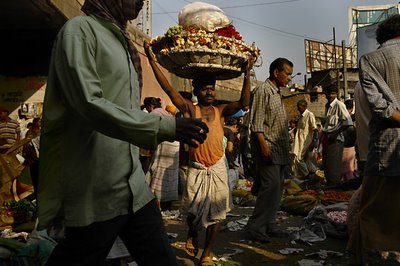
March 18, 2006

yogurt


The only reason I am staying in India at this point is for the yogurt.

I have been eating about a half kilo each day and it’s surprisingly easy to do.
In the evenings, the milk is boiled, cooled, and cultures are mixed in. The warm concoction is poured into large clay bowls and overnight, a wonderful symbiosis between humans and the bacterial world is manifested.
Yogurt, or curd, as it’s commonly known as here has been used for a really long time, perhaps since the birth of the curry! There is little else that can balance-out and cool the fiery spices of South Asian cuisine. My digestive trail is particularly grateful for this side, especially in the swelter of the pre-monsoon heat.

Okay, the only other reason I am staying in India is for the hot milk in the evening time. Because the milk is raw and fresh from that morning’s milking, it tastes different than what’s readily available from the stores in America. Consider the difference between a cup of Folgers’s Crystals from an archaic and overly diluted drip machine, from the back of PuPaw meeting, made two hours before, or a deep mug of just-roasted organic shade-grown from a French press on a Saturday morning, with your lover, sitting in the sunshine in your garden. Or if you have been drinking Maxwell House for the past ever-since-you-can-remember, consider the difference between freshly squeezed orange juice and its quiet frozen cousin. But then, if you drink dead coffee, you probably prefer dead juice and milk too. There’s another way!

Fresh, raw milk is full, creamy, and it’s literally still alive. At least once in a life, one must experience the simple gourmet from a raw food restaurant. It’s just in a different league of taste. There is something else but sometimes one must work a little to find greater wisdom.

In a huge wok, the milk is heated over red and orange flames from smoldering chunks of coal. A metal cup or ladle is dipped into the steaming white pool, filled and then poured back and forth between large cups with a little (or a lot) of sugar thrown in. The pouring froths-up the milk. Finally, some milk cream is spooned on the top and it is ready for prayer and consumption. That is why I am still here. Well that, and it’s still near-freezing in Oregon.
Hot buffalo milk -- fifteen cents for a glass of this nectar of heaven, or cow sweat – however you want to think about it.

I enquired about how much it would cost to send a water buffalo back home but you wouldn’t believe how much they quoted me for airmail! Plus I can’t figure out where I am going to put all of the stamps! Still working on the details such as the accompanying mud bath/bed and typing up all of the notes so that the ship workers know to milk her twice a day and to sing to her in the evenings before bed.

==============
On this note, please take a few minutes to educate yourself as to what the current administration is trying to do to regulate the personal and small-scale keeping of animals. They are wanting to make it illegal to have an animal without a license and probably a computer chip inserted into the animal. This not only affects your personal freedoms but hurts the small-scale industries that deal with locally produced animal products – like fresh milk! Please see these sites for more information: http://NoNAIS.org
Read the USDA's "Draft Program Standards" & "Draft Stratigic Plan" at http://www.animalid.aphis.usda.gov/ on the web. You will see that this plan was developed by the livestock "industry" and RFID tag equipment companies.

A letter or two to your local newspaper and politicians (sample letters available) can ensure that this measure does not gather any more momentum in your state. It has, I am told, already been passed in some states.
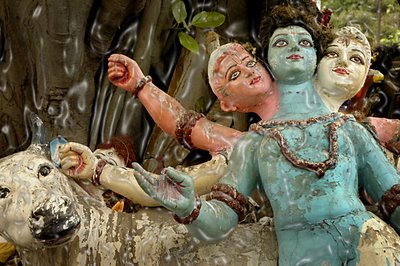


Everything you need to know about Indian symbols and culture, available now, signed, sealed, packaged, and delivered! Call 1-800-555-1212 (ask for: Krishna Krishna Hari Ram). Only $29.95 (for each of the ten installments). Call now!
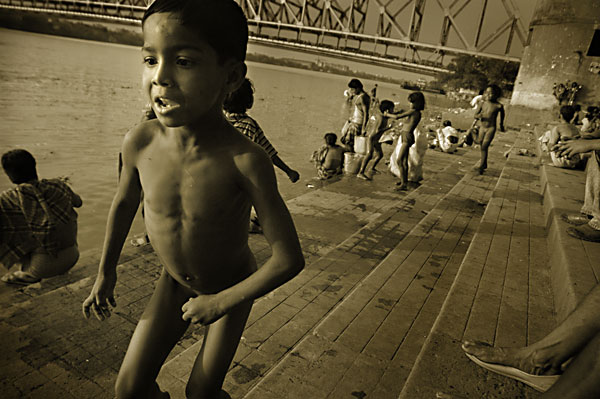
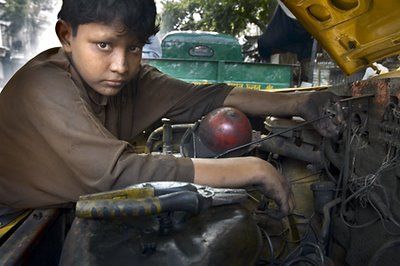
new school

Okay, there are maybe one or two other reasons I am sticking around. I love to watch the ways in which children improvise being children. It’s a place that at first doesn’t seem conducive to being a kid. Why? Few open areas to run and be a kid. The streets are chaotic and dangerous, there is pollution in the shared air, the shared places for swimming, on the grounds beneath one’s feet. But somehow, they manage, in the face of adversity, they are able to be creative: on the streets with sticks, tennis balls, bicycle rims, even other moving vehicles!

On the rooftops with small paper kites dancing in the breeze at the end of a long spool of string. Some children still are able to be children here. Even without the “proper” facilities, they find ways to celebrate the simple joys of living in the moment, living with all-consumed joy – despite the physical obstacles, the noise, the grime, and the chores of work, many even have full time jobs.

Yes, of course, there is also the dark side -- children work here. Many are not given the choice or luxury of really being able to be a kid. As soon as they can do something they must. And so at the same time that I see immense adversity wither with a young person’s laugh or smile, the joy of letting oneself be consumed with the simple wonders of physics in this world or of its critters, I also see children living as virtual servants for little or no pay. I see this everywhere I go in South Asia. Sometimes my mind gags at wanting to label it as bad or tragic when it just is what it is. It’s different here than it is there or over there. But there must be basic human rights that are specific to children that we must all recognize and support. I want to believe that there is more compassion possible for the vulnerable, the inexperienced, the unknowing ones, the ones who are the most receptive to influence.


As I move my body from place to place, my mind takes up new residences also. I open these questions of possibility and being the person I am, I sometimes come up with a plan. I’ll open a school that will board those populations with the least opportunity for social change it will be for those seen as poor, backwards, and illiterate. This renaissance school will cultivate a garden of forward thinking individuals. Everything will be provided for the students.

This will be a place where young women and men can celebrate life through language, art, and sustainable living practices. The core threads that will support this growth will be music, dance, drama, drawing, film, science and math, business and accounting, world religions and philosophies, conflict resolution, public speaking. Daily yoga and meditation, organic farming. Small classes, most everything will be hands-on or group discussion. Students will be able to speak and write in their local language, the national language, English, and an additional language. Cooking. Classes will be taught in 2-3 hour blocks for course lengths of 2-3 months. Open air yoga, dance, and meditation rooms. Students will be well-fed with delicious self-harvested foods.

This school will be from 9-6, six days a week since it’s been shown that children learn better starting later in the morning, because they will be living at the school, and because school will be so cool. Throughout the day there will be many opportunities for physical, spiritual, and mental growth. And because sustainable living practices will be one of the core themes of the school, students will be innovating, designing, and building their work and living spaces, planning, planting, and harvesting their foods, constructing energy and irrigation systems. And in all of this, students will practice sowing these seeds throughout neighboring communities in student-led seminars and adult education classes. Imagine adults learning from children!

I think to begin with, great teachers will be lined up to be part of this school. India Corps and Peace Corps workers may also want to be part of the running of the school. I want to go to this school!
Of course there are lots more but imagine an education that can transform the lives of children who work all day with gunpowder on their hands making fireworks so that their families have a few more rupees than they would if the children were to go to school. I would make it worth the family’s while with fresh organically grown boxes of foods that the students have learned to grow and harvest through the most current techniques of biofertilizers, permaculture, and biodynamics. Teachers will know their field and be committed to learning other ones so that the web becomes stronger in their own lessons.


I can see this kind of school being successful in many different places, focusing on each region’s unique biogeography. Imagine a place where learning happens where the students and the teachers eat good foods, exercise, cultivate a quietness of the mind, and learn practical skills that will assist them to be not only productively creative members of a new kind of society but real renaissance individuals that can catalyze a new future for humanity. Wow, that’s going to be a lot of work! But it sounds fun doesn’t it?!

On other days, I just think about moving out to the Pacific coast in the Northwest and opening up a milk bar (that also serves Indian sweets!).

sometimes smiling, sometimes weeping

“Do not imagine that the journey is short; and one must have the heart of a lion to follow this unusual road, for it is very long. One plods along in a state of amazement, sometimes smiling, sometimes weeping.”

Farid ud-Din Attar, The conference of the Birds: A Sufi Fable


March 13, 2006

riding ganesh


I am meditating on an elephant
Well, not really on one
But in one, within one
I am riding the energy of one
-- an elephant God –
and directing its essence, its life force
up, up, up!
Up through a yellow square with an upside down red triangle
into a breathing pinhole of light
onto my perineal mooladhara chakra.
Breathing light
into and through
even in darkness
into the fire, the furnace,
the cauldron that generates my own alternating current
of life force. I can feel it. Distinctly.
Where was I without this sensitivity?


A plant medicine is pulling open
my own horse-blinders
A little more. Creak-creak. Chips of rust fall away.
I am listening to John Coltrane’s
A Love Supreme
And I am getting it. I am getting it! I am listening to it everyday
And it is f-ing brilliant. I am listening when I couldn’t before.
I am listening and listening. And I like it. This is a new book in a new language.
I am enthralled by the opera of beauty and emotion in the sharing between
and the individual scream.

What has happened to me?


If you want to know, the only way is to become a participant in my being.
Rather than a spectator, you will have to participate in my experience,
overlap my boundaries.

March 09, 2006

the hustle and flow

... of crossing the street in Kolkata!


I am in Kolkata again. Nearly every day I am here, I feel deeper and deeper that this must be my favorite place in India. Well, it's probably tied with Ladakh but Ladakh (in the Kashmir area near Tibet) doesn't really even feel like India and it's the bipolar opposite from this Bengali megacity so they're just in different categories. I love that this is one of the few places in India where every day, and after many trips here, I am still surprised, engaged, occasionally dumbstruck.
It's wonderful and awful, beautiful and horrific at the same time. It's Indian and it's easy to get lost here, shut out from the walls of my own preconceptions and expectations. In fact, getting lost is something that I actually try and look forward to doing here. And after I have left this place, I try to remember the smells. I think about all the ingredients I would throw into the blender: coal smoke, damp dust, ripe and over ripe fruits, old piss, diesel exhaust, and a mysterious Indian masala. And from this description you might surmise, it's hypnotically repulsive.
Things here, unless they are repainted, turn dark. Perhaps that is one reason why people celebrate color so much. And these colors seem even more impossibly rich because of the contrast. I walk, I sit, I watch. I walk, I sit, I watch.
And I make photographs of the crisscross confluence of the unconscious cha cha which is life here. And I feel alive. And I feel tired. But I feel alive.
It's been 95 degrees here and so I have been transferring that sense of climate to Portland and occasionally I fly through in my mind. But I just saw Portland's forecast for today. Its high was more than 50 degrees colder than the high here. The low was below freezing. During the night, I sprawl out underneath a fan and an open window to keep cool. It's still winter there and whatever was winter here is long gone. This is the beginning of the unbearably hot buildup to the summer monsoon season. I am trying to time my arrival back in Portland to "Daytime highs will reach the mid-seventies today. A great day to head out to the coast."
So after a hiatus from this blog, I am back on for a bit. I am back because of a few friends who kept tapping me on the shoulder to start again, to bring myself a little closer. It will be difficult (and it will cost me a fortune at this internet cafe) to recount or summarize where I have been and what I have done in the last two months. Soundbyte: Most of it was in Nepal. Some wonderful adventures in the mountains and exploring Kathmandu. Rest and good eatings. I made many photographs. Today I spent time editing through the ones from Kathmandu, watching slide-shows of these memories and awake dreams. I listened to music while I watched images fade into another and another and I realized that there was something amazing in the collection. There was a thread and a beauty and a new looseness in the work that I really like. I feel excited to see them big.
I've got a confirmation for a Portland show in June. More info on this later.
Ciao friends. Thank you.

January 24, 2006

Barely made it into Nepal after following the great Ganges river through northern India. Early tomorrow morning, I will be starting a journey within this bigger one to walk for three weeks through the Himalaya. It's been a dream of mine for some years and so I am really juiced up at the moment.
Nepal in the meantime is slipping into totalitarian madness and neets a few minutes of your attention and prayers for the wonderful people here. Love to you all.
-raku

a proposal !

Hello. My name is Saag Paneer and I would like you tomarry my daughter dhoti. I have made all of thenecessary arrangements. I understand that you comefrom a fine family, Mr. Loren, and that your papersare all in order. You may come and beg me for myapproval, which I have already granted (this is aformality, of course, no need to break a sweat?) at myabode in Chennai. The address is 23 Nazashreem road#2. Please Mr. Loren, wear your best whites! You area fine fellow...your Web site is very picturesque andphotographic. May you please tell us your birthday andtime for the local astrologer? (this is also aformality...no worries!). Dhoti tells me so very verymuch about you. She has strong feelings about you, butshe is strong in her feelings about most things. I amhappy to offer you my 1970s Mercedes and four goats.Oh, by the way, please receive a complete physical exam and forward the results to the above address..Yours in familial anticipation -- Saag

January 04, 2006

Two audio recordings, a test really, of stories of being on the road, read by yours truly. Let me know how these work in the comments section below. Ideally, they will begin to "stream" (play automatically) although you might have to click an open button. I hope having these read gives some more texture to the experience.

Travelling and Existing
The Stare Factor

I am also taking requests for the next blog story to be made into audio.

Early Morning Fish Market

Early Morning Fish Market, Bangladesh

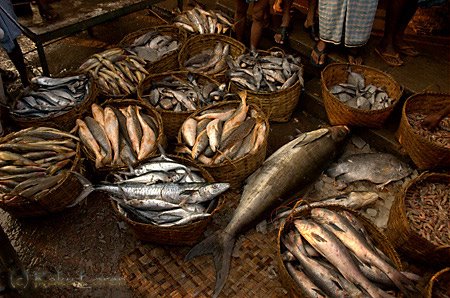
Before the sun rises, before the moon has set, the men and women that farm the rivers and seas are starting the second part of their day. Men who have been out at sea or far down the rivers, working hard for days, are arriving in port with their catch.
Fish provide the main protein source for most of the people who live in Bangladesh, particularly along so many of the country's vast river networks.

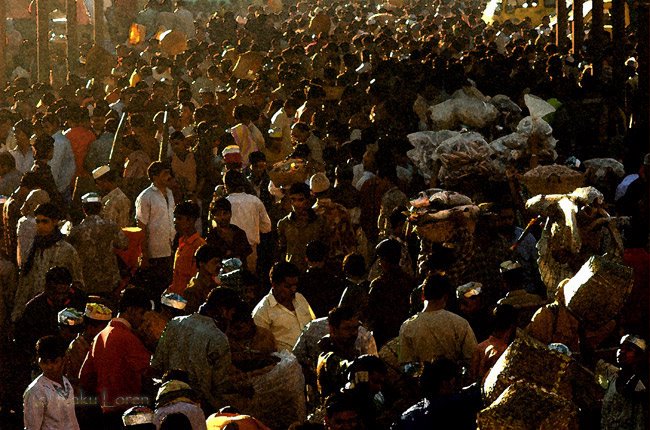
In the first moments of daylight, the outdoor fish market is already packed. Thousands of people swarming -- a beehive of frenetic energy. Boats are unloaded by hand, the fish are loaded into trucks that bring the catch into the "hive." As the loaded-down trucks slowly ply through the crowds, their beds are filled with the fish in crushed ice, wicker baskets are busily filled-up by waiting coolies. These delivery boys carry the heavy loads throughout the market to the next intermediary who weigh the fish, scribbling the notes from each delivery into their ledgers. Moments later, the fish are piled back into the baskets and brought to other people who may prepare the fish, deliver the fish further afar, or to the salesmen and women who hawk it right there in the open air market to the general public who prefer to buy their animal meat as fresh and as close to the source as possible.
There are surges of energy which pass through the market like electricity. It's like the floor of the New York stock exchange. Everybody's calling out to someone else, shouting and pushing, trying to get from one place to another. Haggling is ubiquitous and tensions sometimes run high enough that fights break out over someone feeling they were taken advantage of. Many of the delivery boys are literally young children who carry the loads of fish on their heads. They are barefoot and have only a folded plastic bag that they pull over their heads to protect from the dripping fish and the sharp wicker of the baskets. They work tirelessly making a couple of taka with each delivery. Sadly, they are pushed around by many of the adults. It's not uncommon to see men carrying bamboo sticks which they use on the children as if they were cattle.

Other workers join the fishermen and spend hours working on the old wooden boats and meticulously repairing the nets for the next outing. Although it's still mid-morning, the sun's light is becoming intense to the touch and the men who have been up all night who have just come in with their catches are winding down, getting ready for their next sojourn into the open ocean.

The images.

The Dock Workers

The Dock Workers of Bangladesh

Bangladesh is really a country of rivers. Much of the economy, the country's transportation network, and the social fabric is built on the shifting nature of the rivers. Rivers are the predominant geographical feature of this relatively flat and low-lying country. The rivers of Bangladesh are the tails of the some of the world's most important and most sacred waterways. Nearly all of the rivers begin in the Himalayan range or high up on the Tibetan plateau. During the monsoon season and the swelling of these great rivers, much of the land naps under water. This is one of the great hardships of living on the land here but it is also one of the saving graces because with the flooding, fresh nutrients and minerals are deposited and thus, the land is some of the most fertile in the world.

the wheat grain is weighed before the jute bag is sewn up


Because so much trade and goods transportation is by boat, the workers along the docks are some of the cornerstones for the country's own sustainability. The days are long, the work is arduous, and the pay is barely enough to get to the next day. In these photographs, workers bag and remove the grain of Russian wheat, bringing it to trucks who will then distribute it throughout the country.


standing deep in wheat, workers fill bags with the grain beofre they are weighed.


For more images, visit this gallery.
December 30, 2005

A Night at the Movies

Film in South Asia

The Indian cinema is an institution. It’s stars are the modern gods of society. They are seen in television and billboard advertisements for any number of products from undershirts, to mobile phones, to skin lightening creams! Many politicians started out as famous actors and later used film as their means to ascend into the arena of influencing public policy. Incidentally, I suppose the same is true in America. I mean, even if they knew nothing about the issues, could a Tom Cruise or a Bruce Springsteen lose an election against what’s available? Besides, our politicians are all actors anyways! Some have come from the big screen, others from the pro-wrestling ring. In California, our governor’s training was as a cyborg with a few memorable one liners.

So in that way, things are not that much different here in India but the role of the cinema is much more the pulse of culture. Popular music is first heard in the movies, walls are plastered with movie posters, and for the common man, there isn’t a cheaper way to dream-on-demand. South Asia is the movie capital of the world. Fifteen thousand films are made each year. I didn’t say made well made but they are produced. They all use the same three formulaic ingredients: romance, violence, and music. Together, these films are known as masala movies and they are pure melodramatic escapism for the masses.

While I can’t say I am a huge fan of these films, on occasion, I do like to see what the all the buzz is about. Once I was lucky (or unlucky) enough to be asked to play a small role in an Indian movie. After being dogged for several days by the production manager, I acquiesced with the promise of free food and cold drinks. Later I found out he wanted me to be in an elaborate fight scene. While most Indians would have dropped their pants for this opportunity, I side stepped it and asked for a smaller part. Later I was to find out that one of the major stars in Malayalam movies was one of the actors on set – I had no idea.

What’s interesting to me now is what shape the film industry will take as televisions and satellite reception play a greater role in society. How will the movies change? In photography, digital has taken center stage and made film almost extinct. How will they be made, shown, and what about the rich tradition that cinema has provided society?

I hope to learn more about the answers to these questions and maybe have a little fun along the way. Bollywood, named after Bombay, now known as Mumbai (I don’t think they’ll be changing the name to Mollywood any time soon) used to produce most of the films from the Indian subcontinent. Now, Chennai, in the south, can make this claim. There are Tollywood films because they are in the Telegu language. In Bangladesh, where I am now, the films are from – take a wild guess – Dollywood because they are from the country’s capital Dhaka.

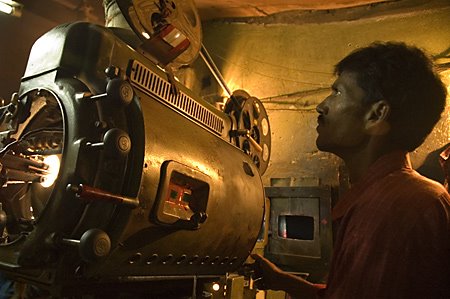
I started making some notes with a couple of visits to the cinema hall in a small town in north-central Bangladesh. Of course, it wasn’t long before I was up in the projectionist’s booth. The images are from the Padma Cinema in Kushtia. The projectionists are Abdul Raja, Aporta, and Hamapara. They used an old Radio Cinema Service projector. Some of the scenes are from outside the cinema where snack vendors offered chai, fresh steamed peanuts and other nuts which were put into cone-shaped pieces of recycled newspaper. One time, my “plate” was made from a page of some student’s math homework! Some of the numbers were recognizable, others were in Bengali.

These images are from those evenings. Enjoy!
If you've seen the images and want to explore more, visit some of my recent galleries.


Images and Text © 2006 Raku Loren
If you would like to use an image for any purpose, please obtain written permission from Raku Loren first. Thank you for your understanding and cooperation.

Images of the Sand Workers (are here)

Okay, if you read the story about the sand workers (a few entries below), you were probably wondering about the link to "the images." Well, through the miracle of technology and a lot of web design frustrations (hehe), I've figured out a better way to show you more photographs. Some of you thought I put down my camera to just write. Nah...
Here they are: The Sand Workers of Bangladesh
Please read the short story if you have not already. It will give some more context to the images.
Enjoy!

December 26, 2005

Travel is fatal...


Travel is fatal
to prejudice, bigotry, and narrowmindedness,
and many of our people need it sorely on these accounts.
Broad, wholesome, charitable views of men and things
cannot be acquired by vegetating
in one little corner of the earth
all one's lifetime.

-- Mark Twain --

December 18, 2005

travelling and existing


So much of traveling is just the ordinary routines and rhythms of existing. It’s laundering clothes in a bucket, wringing them out and setting them on a line to dry. It’s walking barefoot over the concrete terrace in the evening, warmed from a long days sunning and looking out over the neighborhood. Glimpses of dramas and anti-dramas through the portals of windows, doors and other rooftops. It’s Hitchcock’s Rear Window every time I look over at the neighboring building. Each dwelling is faintly illuminated from the inside, each rooftop another world of custom and culture but I know there is a thread between my world and theirs. It’s the listening to the cawing birds and irate monkeys, it’s the smells of kitchens that waft spice and aromatic delights with the shifting breezes in the early evenings.
The more I travel, the more I feel not of one place, but of many. And it is these ordinary acts of feeding, of washing, of getting from one place to another that occupy a big chunk of my time and being. When I am in a place long enough, my own rhythms begin to integrate into the weave around me. I’ll take tea at the same street stand in the mornings. The man who sits cross-legged on the side of the road has my newspaper folded up, ready for me as I approach – whether I want it or not. And while I usually don’t, I’ll get it anyways because the interaction alone is worth a couple of rupees. Again and again, my path connects with the young boy who washes dishes on the sidewalk in front of the restaurant from morning till night and we exchange side-to-side head tilts, smiles, and some kind of subtle yet satisfying acknowledgement for each other’s existence. It’s the juice-man’s smile and it’s the guard in front of the bank in his overly official looking uniform that sits unmoved hour after hour whilst busses and taxis blare horns and cough exhaust just meters away. Unflinching, he’s completely absorbed, dissecting every bit of his newspaper. And the neighbors who I sometimes see on the roof of the next door building and sometimes down below on the street, sitting, talking, gossiping, as their children run in circles, laughing. It’s seeing these people each day and our brief expressions of communion through words and gestures that help take the edge off being alone – or at least feeling that way most of the time.
Being on the road in the ways that my experience is driven often means sitting, wilted-over, staring at the floor or the wall, alone in my room, trying to make sense of something that I may not even be conscious of yet. But there too are wonderful moments when through the dark of night, the sounds of classical Indian music haunt the stillness of space between the gods and wherever I am. A woman singing with her harmonium and there is no place that I would rather be than across this bit of still air and flowers of jasmine. And then there are the children that dance small homemade kites from rooftops from here all the way to the horizon that create a sea of birds in the orange hazy fire of a big setting sun.

Being away like this also means seeing more clearly where I have come from, where I have been, and where I want to go. Most importantly however, being away seems to help me see that wherever I am, it is just here – wherever that may be. And so I learn that it is less about here or there but just being in the world and noticing, seeing the beauty in the everyday expressions of existing, feeling my being in the present, and allowing it to communicate with what seems unknown, challenging, irritating, or uncomfortable. When this happens, the notion that I have traveled somewhere else drops and I realize that these places that I go are part of my being, part of my practice in just being. Choosing to go where there will be the alarm clocks of unknown territory help me ensure that I sleepwalk less and remember more.

rivers


The waters of many of the rivers in this part of the world either start high up on Tibetan plateau or originate from the mighty Himalaya range. Eventually, as in nearly all rivers, the water finds its way to the sea. Along the way, it weathers the rock that it meets. And from this interaction, sand and silt are brought down to the plains. It is within these northern plains in the Indian subcontinent that one of the highest population densities in the world exists. And this is in part due to what the rivers bring here.

Even in the monsoon season, when the waters rise to “catastrophic” levels and humans experience disruption and destruction in their lives, the land breathes, it is once again nourished with the mineral silts that have washed down from the “abode of the gods”. And this is one of the main reasons so many people live here and have done so for thousands of years – the land is self-replenishing. It is one of the richest agricultural areas in the world. If land typically is able to support one or two crop harvests per year, here, the land can support three or four.

From California to Calcutta, from Mexico City to Madrid, from Santiago to Shanghai, populations have been increasing rapidly and as a result, land is becoming more scarce. Land once used only for agriculture is being developed for homes. Just as large animals need a range of land to exist, so does a river. And encroaching on either’s territory leads to conflict if one’s aim is to dominate the other. So many people are desperate now to just survive, to care of themselves and their families, they’ll risk living in these zones.

Rivers don’t aim to wreak havoc, they just do what they do. They breathe in and they breathe out. We can try to control this breath but sooner or later, a river will set itself free. Here in the northern plains of South Asia, the most important rivers are the Ganges (and Padma), the Brahmaputra (and Jamuna), the Indus, the Narmada, and the Yamuna. Over the next decade, I hope to help tell the stories of some of these waterways and of the relationships that people have with them.

In this part of the world, a river is held in a very different regard as it is in the West. While there is unfortunately little concern for what goes into many of the rivers here, the body of water has a soul and it is respected and prayed to as the embodiment of a god. And in such, since god occasionally (or regularly) punishes us mortals, the river is also feared and so it is not uncommon to see offerings being made, prayers being given to the river so “god” will protect those offering puja. It is the Hindus that cultivate these relationships while Muslims go to the mosque or make their prayers in the direction of their holy city, Mecca.

When I see and experience the relationship that people have with a river or the ocean, most of my western, scientific, skepticism is left elsewhere. Usually, I am taken aback by the devotion that people have. And there’s a part of me, that because it is a form of very personal devotion where they are not trying to convert me or make me wrong for some reason or another, that I am able to relate to this kind of relationship. While my own worship looks, smells, and seems different in many regards, I feel connection with some of the devotees out of shared reverence, respect, and gratefulness for this natural element and for the life that it gives.

The important rivers are also theatres of life and society. The intimate rituals of life and death take place along its shores. For thousands of years, people have been making pilgrimages to some of the same places along the rivers to make puja (prayer) and to bathe in its sacred waters. For the Hindus who do this, to die in Varanasi (which I hope to visit again on this trip) means being released from the endless cycle of rebirth, samsara. Not having to be reborn as a human again and experience all of the suffering that we humans endure is quite the motivator and so people from all over India will make their last pilgrimage to this city to wait out their final days.

The rivers in this part of the world hold a different place in the lives of the people who live along its shores and depend on it for their livelihoods. Rivers and the lives of its peoples all over the world are changing; I hope to shine a light on some of these experiences, some of these relationships, and some of unexplainable that only a great river can sing.

rivers and sand

One of the seemingly never-ending gifts of the river is sediment. Sand is one part of this. In slow moving waters, the coarse, and relatively heavy particle is found not on the banks but on the river’s bottom. Sand is one of the primary components of cement which is the primary means of building and construction, particularly in this part of the world. And thus, just as there is a huge demand for construction, there is a huge demand for sand.

Interestingly, sand, for the most part, is collected by hand. Here, workers collect from the river’s bottom this important ingredient to our modern lifestyle. But in such an un-modern way, these workers dive into the water and swim to the bottom carrying a large bowl. The water is cold, the currents can sometimes be strong, there are a lot of other things in the water, yet the (mostly) men scoop-up sand, swim up to the boat, dump the bowl’s contents into the hold and swim down again for more. For ten or twelve hours in a row, day after day. The work is both dangerous and oppressively difficult.

But for so many, who have not been educated and are not literate, who have fallen on hard times, whose land may have been taken away by the rising waters caused by large dams downstream (ironically built with cement! and funded by equally large multi-national corporations) or stolen by land developers more cunning and ruthless than they, many of these workers have no choice – there is little else they can do. And if that means earning only 60 taka ($1) per day (this wage is below poverty, but above minimum wage, even in Bangladesh), they will do it because it is work and they feel lucky to even have a job.

In an even greater demonic irony, along the Narmada river where some of the following images were made, the sand quarrying work is being done in a part of the river which is slated for submergence because of a massive dam being built downstream. These dams create reservoirs hundreds of kilometers long making this kind of work virtually impossible because the water levels rise so much.

So to summarize:
people collect sand for work ==> sand is used for cement in construction ==> dam construction causes people to be forcibly removed from their agricultural rich land upstream ==> once farmers, people now live in squalid conditions and find any work they can (communities, families, ways of life for generations have been uprooted) ==> construction is always booming, sand workers needed ==> rising waters from dam construction eventually reach their work area, water is getting deep ==> work becomes even more difficult and dangerous ==> eventually, work can not be done in that area, people are left without work ==> (In desperation, many move to the cities. In the city, their language is not spoken, they have no “skills”, and must fend for themselves. The situation continues in a downward spiral.)

More on the very special Narmada River here: story , images

If nothing else, I hope that the following images will at least speak on behalf of the river and for some of the people whose livelihoods depend on the river: Images

December 14, 2005

The Stare Factor

This being Bangladesh, group staring is something I have become accustomed to. It seems that wherever I go, I attract a crowd of curious onlookers and open-jawed, expressionless gawkers. Once in a while I am able to derive some humor from the situation but usually I just feel encouraged to move on. I am learning some clever phrases to break the monotonous, blinkless, public hypnosis but mostly, it’s just a way to amuse myself and whoever I am talking with. However, the hyper-attention I draw makes it extremely difficult to do any sound recording or photographic work when within moments of my arrival, the situation I have come to observe or document has completely changed due to my presence. If I remember correctly from cultural anthropology, this is known as the Heisenberg-Bengali Uncertainty Principle.

I’ve been told by Bengalis wanting to explain the hypnotic effect I have on people that I am probably one of the most interesting things that has happened for some of these people for quite some time. While I find that difficult to believe, the reality is that something is happening. The crowd might be diverse enough to include young rag-picking girls to old Muslim men with white beards, skull caps, and traditional Islamic dress. They all behave the same. Mostly though it’s the lungi (a leg length, long piece of fabric that is wrapped around the waist) wearing young men, the uneducated laborers, the overly-worked and under-paid who perhaps see me as a potential free movie.

This has forced me to make photographs in new ways. I’ve had to fine tune my ability to see something, compose the image, and press the shutter with unprecedented speed and agility. If I wait for even three or four seconds, that candid scene will be invaded by unwanted extras. Necks will crane into the frame from nearly all four sides of my viewfinder, and the boldest will just jump-in, thinking that with their presence, the image is now complete. Please don’t ask me how many great images have become digital carpet on the cutting room floor of my laptop trashcan due to overzealous teenagers!

And as you can imagine, a crowd of people just attracts more people. Soon, people are piling over people, everyone rubbernecking to get a glimpse of the alien freak/possible movie star. So unless the idea of thirty people gathered all around you, watching your every move is shanti-shanti then you’ve got to keep on moving. This is probably the thing that is the most difficult for me, being here, trying to work on my photography or just weaving into the fabric of life to observe and to learn. Even eating parotha and drinking my chai in the morning can come to resemble a celebrity book signing or at the least, a situation where I am the subject of some reconnaissance mission, where every sip of tea and every tear of fried bread between the fingers of my right hand are being noted and privately commented on.


I really wish that I wasn’t as interesting to the people here as I am. And this is Bangladesh’s second largest city! – it’s only more intense in the villages. There’s really no where to hide from Bengalis outside of my room. There’s a certain relief when I unlock the door to my room, slip-in, shut the door, and slide both of the bar-locks over. It’s the one place that I am reasonably confident that there will be no Bengalis. That’s why, last night, when a couple of new Bengali friends invited me to stay at their house instead of spending the 150 taka (two and a half dollars) on my hotel room, I immediately declined and felt no guilt whatsoever. Without the retreat, and the relative quiet of my hotel room, I explained to them, I would probably blow a fuse.

I don’t want to give the wrong impression; most of the Bengalis that I have met have been extremely kind and generous. And while their ideas of America are almost absurdly fictitious, they mean well, and can only be blamed for believing everything they see on TV and the worst of the western films that get this far (these usually never play in the U.S. – they’re that bad).

It’s culturally accepted here. It’s not just me – or at least this is what I tell myself. It seems that Bengalis will drop whatever they’re doing and gather and stare at anything unusual. It isn’t considered rude to stare at someone as it is in the West. Still, even with these reminders, it’s challenging sometimes because I feel like my whole life is in the center ring of some visiting circus. From eating meals, to asking someone for directions, to taking a piss with other Bengalis on the side of the road, to just standing still and watching the movement of the world in front of me on the street, my presence evokes an intense curiosity.

If it were one person, it might feel less overwhelming. Having a whole group gather is another thing altogether. There are interesting dynamics within these group stares too. For example, often there will be the show-off who will assertively ask, “Your country?” If more English is known, these truncated questions will follow. If not, the same, predictable questions will be asked but just in Bengali. The answers will be reiterated to all of those who are standing around – as if they did not hear or understand what I had just said – in Bengali. People will then reiterate to each other for a third time the answer to simple question before refocusing their gaze my way for more information. Sometimes I feel that I must wait to answer a new question until the third reiteration is complete so I am not asked the same question again after having just answered it!

There will often be a teenage boy who will come in to “rescue” me. He will swoop in and threaten the younger kids with a raised arm and an open palm. The kids will scurry off several steps away, just out of hitting range but still within ear and eye shot of me. Then the older boy will assume their original position and begin his staring! It is a starevival of the strongest.

Sometimes I use the partial cloak of darkness to mask my identity.
It’s easier to go for a walk in this way without drawing as much attention. I guess in my own way, I am curious too – of them. In my own watching, in my own focused attention when I am making photographs, I suppose I too am staring to a certain degree. Being stared at takes quite a bit of getting used to. I think if I were to live here, speak the language fluently, it would be the same. For them, I will always be the outsider. Ultimately, if I want to keep my sanity, it is I who will have to change – I’ll have to change the way that I think about being stared at. Maybe try to see it as a compliment?!

The Poo Room

Chittagong, Bangladesh

Pacing oneself on a longer trip such as the one that I am on now is important. Taking days to catch-up physically, mentally, or with sleep are essential. When I am traveling for an extended period in a place with so many “foreign” elements, staying healthy requires a lot of attention. Because of all of the different kinds of things I am ingesting through food, water, and the ubiquitous dust that gets blown and swept-up I try to have a couple of stool tests done for my own piece of mind. They cost a couple of dollars each and a good lab will provide a computer print-out which details any parasitic or amoebic activity (hopefully the lack of thereof) in my digestive system. A test like this is comforting particularly during those times that I am squatting over an Asian toilet, wondering, just what in the name of Kali, has gone wrong. So last night I was out on a stroll and I saw a sign for a diagnostic lab down a little side street. I decided to stop in and pick-up a plastic test cup. I walked in and within a couple moments, all heads in the waiting room were anthrotropically tracking me.

I continued past my new audience to the front counter. I was greeted with a “Yes?” I thought, ahh, English! Hopefully this wasn’t going to be a one-word decoy, an illusion to what the rest of the conversation would look like. Well, it was. Neither of the desk staff spoke more than just a bit of English. So I’d like you, the reader, to put your thinking cap on and just try to imagine how I tried to explain in broken Bengali, English, and non-verbal communication what kind of test I wanted.

This went on for an unreasonable and torturous amount of time. I found myself digging within my mental thesaurus for every synonym of “poo” that I could come up with. From polite antonyms to baby talk, I began using less language and more non-verbal gestures and even a few mouth noises. At one point, I realized that my efforts were going no where, I realized that I had been defeated. Charades was simply a game that people don’t play in this country. I decided to withdrawal, to slink away as impossibly inconspicuously as I could before all of my pride had been spent. The fact that there was a silent audience behind me just italicized my desire to vanish into thin air at that moment. I am glad I am not staying in this neighborhood, I thought, knowing that the sanctity of what just happened in this room would not stay in this room.


Late night at the neighborhood pharmacy, north-central Bangladesh

November 29, 2005

the invisible line

November 2005
Right before my previous trip to India I lost my passport. It was awful timing. Fortunately, I was leaving from San Francisco so I could get a one day rush passport replacement as well as the Indian visa from the embassy there. I didn’t have the time to replace the long term visa for Bangladesh for which I had wanted to visit and had gotten from the embassy in Washington D.C.. So on that trip, I skipped Bangladesh and spent my time trying to swim a little deeper into the vast Indian archipelago of culture and geography.

About a year ago, I found that “lost” passport and seeing that special five year visa, the stamp taking up an entire page in my passport, seeing the letters of the country’s name, my enthusiasm was rekindled and the electromagnet of the country’s mystery was switched on – I immediately felt the pull.

On this trip, I decided to pack along this extra passport and the still-valid visa to see what I could do about it once I got to India. After landing and spending a bit of time in Kolkata and in preparing for my overland entry into neighboring Bangladesh, I went to the Bangladesh embassy to see if I had to get a new visa. Not surprisingly, the price had skyrocketed for American citizens. I hoped they would see that the old visa was still valid for several more years and could transfer it over to the passport I was currently using. Okay, this thought might have been a little overly optimistic considering the sympathy that paper pushing agencies have, particularly in this part of the world.

Well, it was to my surprise that after explaining my situation to the officer, I was told that the visa was still valid and so there was no need to get a new one! I explained the situation again, emphasizing that the visa was in an old passport that I was no longer using, hoping I could change her mind into manifesting the reality that I guess I was expecting. Nope, she wouldn’t budge. The visa was still good and there was nothing I could say that would change her mind.

A man who walked up behind me in the queue repeated key phrases in English that she was making like, no problem and visa still good and in my irritation at being double teamed, I turned to him and said, “Excuse me but do you work here or something?” He replied, “Yes I do” and that shut me up so I turned back to the counter and moved on to the next argument against my case. I said, “Look, when I get to the Bangladesh boarder, and they can’t find Indian exit stamps in the passport I am using to get into Bangladesh, I know they are going to give me problems. Can you at least write me a short note that explains that I was here and you have given me official permission to use this visa?” She shot back with a confident smile, “Not necessary. The visa is still good. Just show them both passports and explain what you have told to me.” “Come on,” I said, “as soon as they see two passports from a gora (a white person), it’s going to be baksheesh (bribe) central! Can you just write a short note? Please!”

Slight variations of this exchange went on for several more minutes. I joked with underlying anxiety that I didn’t want to arouse any reason to strip down the foreigner at the border but the officer adamantly danced around putting anything in writing for me. In bureaucratic India, no one wants to exert any more energy than they have to, particularly when it means putting their name on something like this.

However, in my stubbornness, I wouldn’t leave my position at the counter without something. As if we were in the market and I was purchasing a kilo of bananas, we came to a compromise: she would write the embassy’s phone number on a piece of paper and if there was any problem, they could just call her for confirmation. She almost got away without any accountability. I pushed the paper back to her and said, “And your name?” She obliged and scrawling her name on the back of the paper, she pushed it back through the small hole in the barred-over window. I folded it up, slipped it into my pocket and walked out. I felt both some satisfaction and some lingering trepidation that I tried to cast off as the little Mr. Cynic on my shoulder.

(Jump ahead. Scene: I am sitting in immigration on the Indian side of the India-Bangladesh border. Outside, it is a crazy gridlock of cargo vehicles, money exchangers and their aggressive touts, jewelers, official-looking military personnel/cops who are milling about, and a sense that some illegal things are going on here and it’s being permitted. Busses, taxis, and rickshaws are dropping passengers off who are scuddling about before walking across the no-man’s land between immigrations checkpoints before getting on a different vehicle to continue their journeys. There is a sense of urgency to people’s movements. The immigration office is like an old jail. Musty cement-block rooms. I’ve been told to “Sit down.” several times, so I do.)

On rolling up to the end of the road on the Indian side, a bus attendant collects all of our passports and puts them into a plastic bag. Because I am the only foreigner, mine is kept on top of the stack. As the bus neared its stop in the frenetic congestion, the attendant hopped off the bus and jogged away. I reflexively bolted over to the window to get a good look at his stature and dress in case I had to track him down later. In that moment I felt naked without my most important document. Sure, everyone had given up theirs too but I was convinced that an American one might “fall out of the bag.” Usually, if I have to hand it over to someone, I make sure I stay within eyesight of their movements. Now, it was gone and my next priority in my survival triage was to get to the rear of the bus before someone made off with my bag. I think everyone else had the same feeling because we all jumped for the door and scrambled around to where the bags were already being unloaded, claimed, and some, tossed over a metal fence onto concrete. I nicked mine just in time to avoid a broken DVD burner. Why some bags were being sent over a fence I reasoned, was for their transfer to another bus. Why they were being pushed over a fence to land on cement was beyond me but I just pushed the incident into my dusty pile of unexplainable Indian phenomena that I might revisit someday while sharing stories and misadventures with other graduates of travel on the Indian subcontinent.

Bag in hand, I was now on a mission to find the man with the crazy looking shirt (and the bag of passports). Sliding through the slim margins between lorry trucks, I walked in the general direction I last saw him trotting off in. After about ten seconds, I realized I was without any bearing and had no idea of where to turn. It seemed everyone on the bus had scattered off in different directions. I saw someone I thought I recognized from the bus and tried to catch up with him. After crossing the congested road, a flash young man approached me with a dark blue passport in his hand. “Follow me” he said. That was my passport and I made double time to keep up with his pace. He was doing business (whatever that was) and I was lugging overstuffed bags, heavy on my shoulders. I wasn’t going to let that little paper book out of my sight again.

I followed him through a long dark corridor and into a room where people were calling out to me to change money and I knew at that point, something’s wrong here. I kept checking in with myself, “Okay, I’ve got all my bags and my passport is right there, he’s holding it.” A few moments later, the power shut off and the room went black. I am standing in the dark, back pedaling to the chair where I had set down my duffle bag. For a few moments, my passport became just a fiction and the pulse of blood into my head seemed to amplify into a strong surge that I could feel in my neck and at the inside corners of my eyes.

Amidst, groans and the mixed voices of people who were all complaining in Bengali, bolted the words “Follow me!” his voice finally emerging from the darkness. I hoisted my bag up and moved blindly towards where I thought the voice was coming from. I followed his faint silhouette to the door and to the dim corridor outside. He walked in trot down the hall and I struggled to keep up while keeping the straps of my bags on my shoulders. We made it outside, crossed the road again and entered another building where we shuffled down another hallway. This one was unkept, dusty, and a bit moist. On seeing me, people in the building turned for a second look. Don’t dwell on that, follow the passport! I told myself. We stepped into a room where men sat around a variety of tables and the sounds of rubber stamps being hammered onto torn up, half dry ink pads echoed from wall to wall. The flash young man handed my passport over to another man at a desk and rattled something off that I couldn’t get any traction on. I assumed I was in the immigration office and figured the rest would be a breeze.

My first clue that things wouldn’t be smooth sailing all the way to the Bangladesh-side bus was the number of times that I was told to “Sit down” in the moments after my passport was slid across the desk and the two men had spoken about me. One of the men turned to me and said you have no Bangladesh visa, you have to go back. I had anticipated that that’s what this was all about. I explained with an aire of complete confidence, “Oh yes, the visa is in my other passport.” Eyebrows rose, the officers hand shot out, “Let me see it.” I fumbled through the money pouch around my hips and produced the book in question. I attached the verbal story to the document as I handed it over.

The immigration officer slid both of my passports into a desk drawer and finished up with several passports that were there before me, entering the information from each into maddening non-carbon copy paper triplicates – ahh, Indian bureaucracy! My instinct was to get my camera out and make a few snaps of all of this, including the group of gawkers who had by this time formed a semicircle in front of me, but I realized that this would be probably be unwise and wouldn’t help oil the chain of the bike I was riding.

The gawkers around me started to field questions my way. They were the usual curious kind: “From what country? What is your occupation? Why are you going to Bangladesh?” I started answering each of their questions with the kind of politeness and confidence that one tries their best to espouse in the face of knowingly undeserved reverence, such as with slimy immigration officers (you can see I’ve only had positive immigration experiences in the past). That quickly changed when I felt that these were mere peons in the hierarchy of who was going to actually do anything about my case in that room. When one asked me, “When did you arrive in India?” I shot back, “It’s in my passport with all of the other information you are asking about!” That muffled any more personal questions and they instead just stood there and looked at me.

In India, this staring is something that a person just has to get used to keep their own sanity. (I was to later experience the nerve-racking and ultimate test of endurance, the gold standard of all staring cultures, Bangladesh in all of its infamous glory and the torture by silent-staring technique whose method was secretly smuggled out of the country in the early eighties to assist several U.S. backed military coups in Central American nations who had actually used the democratic process to elect their governments.)

After making some noise about the connecting bus that I was supposed to catch on the Bangladesh side, for which I had already bought the ticket, the officer started asking me questions and eventually got to his main point: “You have two passports.” “Yeah?” I countered. “I wanted to get a new visa in my current passport but I was told by the officer at the Bangladesh embassy in Kolkata, yesterday morning – you can call her, that this is fine, the visa is still valid and I am to be admitted to Bangladesh.” There was a bit more arguing and he got to his second point: that my situation was bad and that I might be put in jail.

At this point, I thought, I have two options: freak out and melt into a sobbing fool or become the come-from-behind attorney who stuns the jury with his logic, delivery and aptitude to play onto their emotions and hypnotize them with surgeon-like confidence. I had but a moment to weigh the pros and cons of each choice. All great actors at some point play the courtroom lawyer. Today was my day.

Earlier I had seen an applicant slide a few hundred rupees across the desk in an overtly casual manner with his passport. This immigration officer made a gesture like, Oh no, I don’t do that and pointed to his assistant who quickly collected and pocketed the cashola. I wasn’t surprised in the slightest. There is so much crookedness in these kinds of matters, it just reaffirmed my detest for anything that combined Indian bureaucracy, unneeded complexity for the man with less perceived power, and this ridiculous charade of reverent formality. On telling me of this potential penalty, it seemed as though the immigration officer was leaving a slight window open, just slightly, as though I had a choice whether I wanted a hearing or not. I knew that his comment of six months in jail for having two passports was supposed to evoke a certain kind of response that would look something like a fat wad of rupees. And I knew that it would not be cheap with a threat like that.

In all fairness, I hadn’t knowingly done anything illegal, I wasn’t trying to pull one over on anyone, I had done everything I thought I was supposed to do, and I wasn’t smuggling in weapons. “Yeah, go to the magistrate, I want to talk to your boss.” I told him. He shuffled out and I had the sneaking suspicion that he was just on the other side of the door planning-out with his assistant how they could avoid the lengthy hearing and go for the gora’s jugular – the one in my back pocket.

(And now an important message from our sponsor: “The cost of a straight blade shave on the street in Kolkata: twenty rupees. The cost of a beer at the chic Tantra night club: 200 rupees. The cost of an overnight train trip from Kolkata to Chennai in 2nd class sleeper: 450 rupees. The cost for entry into the Taj Mahal in Agra: 30 rupees (or if you’re white, 800 rupees!). The cost of a bribe to stay out of an Indian jail for six months: priceless. Mastercard – it’s there to keep you out of the places you don’t want to be.”

Like clockwork, the flash young man that I had followed in who held my passport came into the room and waived me over to a place where people could not hear what was going to be said. He whispered some half intelligible non-sense about six months in jail and that things were looking really bad for me. And…I might be able to pay a fine. Curiously, I asked him how much it would be? He answered with the rubbing together of his thumb and index finger. I knew what that meant. Surprise!

“No, I am talking to the magistrate and that’s the end of that.” I said. He tried to reemphasize his offer but I wasn’t going to have anything to do with it and I brushed him off with a few go away flicks of my hand.

I don’t think the magistrate knew what to do about me. I was a dressed nicely, sat in the center of a group of eager assistants who were trying to catch-me-up on something and were all being stymied by my inability to be bullied or backed into a corner. He watched as I was the one on the offensive with his lackey paper-pushing juniors who had aspirations to be chosen to move up the hierarchal ladder within the relatively stable governmental bureaucratic environment. When he stepped into the ring and started firing questions that didn’t allow time for a complete response, trying to trip me into a bog of fiction, I protested his technique and asked for tea so we could have this discussion in a civilized way. He couldn’t find reason to refuse this request that I knew must have still held historical remnants for him. When I put my hand in my pocket to dig for a few rupees to give the chai boy, the lower immigration officer shook me off with a hand gesture and than emphasized this expression with an English phrase he had memorized, “You are my guest.” I thanked him and knew that the chai bar was now open.

The magistrate wasn’t able to find fault in the answers to each of his attacks and finally used his last strategy, the one that he was sure would put me into a full-nelson: the letter of the law didn’t allow citizens to hold two passports. This was a crime that was clear and straight-forward. I took a deep breath and sighed with an expressive exhalation. I shook my head at him and said, “I’m not an Indian citizen.” He replied with a confused and startled look on his face. I went on, “We don’t have the same rules and procedures in my country. They do not require us to give up our found passports at the police station and get all of these documents that you’re mentioning. Clearly, I have followed all the rules, my intentions have been to do the right thing, and you can see that I have made every effort do things correctly.” I emphasized this by sliding the piece of paper that the officer of the Bangladesh embassy had written for me, with their name and phone number on it, across the desk to the edge on his side. “Call her, go ahead. Her name and number is right there.” I pointed to this obvious information. “I am sure she remembers me – it was just yesterday morning.” I was now egging him on with a challenge. He turned to the person who had been his primary tag-team partner in the now two hour interrogation and started barking something that I couldn’t understand. It seemed there was disagreement between the two. The other man was the immigration officer who I had initially dealt with, he was the one playing the bad guy.

Actually, as time went on in the verbal hammering of this small concrete room, I started to think that this officer’s act was in fact, his reality. He seemed generally irritated -- not just about my case but in general. On several occasions, I shined a light on this and used it to my advantage. He would shower me with sharp questions with a menacing tone and the dramatic facial expressions of the villain from a Bombay masala movie. A couple of times, I saw in him the Bollywood actor that never got his shot at stardom, still playing the part he had been practicing alone in front of the mirror since his childhood when he was first impressed in an Indian cinema. I would smirk, wanting to let out a chuckle at his knightly efforts. That seemed to prod him in the ribs and as a result. he would turn up the gain on his determination to dominate me, which of course made my timely protests to the magistrate even more legitimate.

On one occasion, I put my arm out towards him, palm stretching against my line of sight with his face and turned to the magistrate and said, “Could you please ask this gentleman to speak to me not as a criminal but as a human being, as his guest?” The magistrate paused for a few moments, I think, to figure out how he was going to translate this to the officer. He did and the officer sank back from the edge of his chair and went blank.


(another scene from the action that afternoon)

With time, the magistrate was clearly taking my position and was shouting at the immigration officer who was proving to be part robot, part bulldog. Neither of them wanted to call the Bangladesh embassy for some reason and so they kept trying to put the responsibility of registering me onto the other. Finally, the magistrate relented and we walked back to the main immigration room where all the men at scattered desks were waiting with anticipation to witness part of this melodrama.

The magistrate grudgingly opened the first of the in-triplicate registration books. He thrust his chin up to better see through the bottom of his bifocals and thumbed through the pages. After several more agonizing minutes (Just enter the information and stamp my passport before you change your mind!), we came to the point that both he and I were relieved to reach: for him I would be out of what remaining hair he had left and for me, so I could just get the hell out of there. It was just about dark now, my bus had left three hours ago, I had no idea what I was going to do in this border town that breathed a menacing wind. This wasn’t the kind of place you would want to hang out in and I was pretty sure the Bangladesh side wasn’t going to be any more inviting!

In the minutes before we finished completely, I crossed the mental fence several times over whether I should say one last thing. Nah, just be glad it’s over and get out. Do it man, make a stand for what you think is just! Ready to just be done with this whole incident, I stood up to leave. My heart was pounding through my chest and head. I lifted my bags over my shoulders and with stood with physical stillness to silent the room, I addressed the magistrate and said, “I have one last question.”
“Yes?”
“I know that there are probably other rules that are different between our countries and I was just wondering – is it illegal for a government employee who works in the immigration office to accept baksheesh (a bribe) from an applicant?”

“It certainly is!” he replied.
“So it’s a crime? It’s against the law?”
“Of course.” Everyone in the room was motionless, the room had gone quiet and all eyes were now on me.
“Oh! Huh.” And with that, I panned my gaze over to the immigration officer. I could only make a guess at what the temperature was reading right around his collar.
The magistrate asked, “Were you asked for money? Did you pay a bribe?”
”No. I didn’t pay a bribe. I was just curious.” I looked back at the immigration officer to speak without saying anything. After a few long moments I turned back to the magistrate and thanked him in Bengali and offered him the appropriate Muslim farewell. I then strode out of the building into the night half-expecting some kind of physical confrontation by the officer’s goon-dogs.

Sure enough, out they rushed to follow me for a bit. I turned around with a straight on look and inflated my chest (later realizing that this gesture is shared by male species of feather and scale all around the world). The flash young man with the crazy looking shirt, who was now standing in the middle of several of his assistants, slung his arrow, “They’ll put you in jail. Bangladesh side. Very bad.” He gestured in the direction I was walking. “Thank you for your help. I’ll remember you.” I pointed back at him between his eyes. With that, I spun around and picked up my pace to the final gate on the Indian side, stamped passport in hand.

The uniformed man at the fence inspected my document and waived me through. I had made it, well, at least to no man’s land! My bags bounced with my long strides. I took a place in the queue to have my bags hand inspected by the Bangladesh security team. I couldn’t wait for them to find all of my interesting toys to ogle at! A security supervisor seeing that I was a white man, waived me forward; I wasn’t to wait in line with all of the ordinary locals. This was one time I didn’t feel a bit of guilt in conceding to the demand that I cut the line because of my skin color – I just wanted to get out of this place. I placed my bags in front of him and showed him the Bangladesh visa in my other passport. He compared the picture with the face on my head; I tried to embody the youthful and innocent look from that old picture. He decided not to open any of my bags and waived me through.

I pushed my way through a throng of Bengalis that were standing on the Bangladesh side, waiting for their friends and relatives that were coming over. I had crossed the invisible line and was now in Bangladesh. I just had one more thing to do – get through Bangladesh immigration.

The first order of business was finding the building. I asked several people and they kept pointing towards a group of overburdened lorry trucks, parked in the middle of the road. I decided to head in that direction and squeezed through the thin gaps between them. Now that they were behind me, I could see that there was indeed a building on the other side of the road. I took a few deep breaths and walked inside. Again I got priority treatment because of my tall, radiating good looks. I put the passport on the desk in front of the man and greeted him first as a Muslim, then as a Bengali. He was surprised and asked me if I could speak his Bengali language. I charmed him and said that I could only speak a little and gave him a big smile. He repeated my response to the other officers on duty and they all had a delighted chuckle. He gave me a form to fill out that asked about the time and the reasons I had for visiting his country. When I got to the ubiquitous “Father’s Name?” space, he asked me where my exit stamps from India were.

Now my temperature was rising. Sweat glands around my face were kicked into high gear from a combination of the thought of again going through what I had just narrowly escaped from, the heavy bags on my back and the dark, humid, still air inside the small crowded room. I decided to forget getting into any kind of explanation about it and so I just reached into my belt, retrieved my other passport, opened it up to the exit stamps, slid it over to him and put the tip of my index finger on the mark in question and went straight back to the application that I had been filling out. I didn’t bother to even look back at him. I didn’t want to leave any space for anything to arise. In a few moments I had finished the questions and presented it to him as if I had done this many times before.

He stapled part of it in my passport and reached for his rubber stamp which he pounded into the near dry pad a few times before giving my book the seal of approval. I thanked him in Bengali, he and several others around him smiled, and I made a turn for the door. I stepped out into the cool night. I was now in Bangladesh.

Something so simple which had become so messy was now as real as the breeze that cooled the moist skin around my neck and face. It was now dark and the evening was nowhere close to being at an end for me. I had to somehow figure out how to get to a place that was five hours away by narrow, bone jarringly bumpy roads.

This proved to be easier than I thought after I met a young man named Obaidul Islam whose heart was big and bright and who spoke remarkably intelligible English. He took me under his wing and made sure I found the right bus which wouldn’t be leaving for a couple of hours. We sat and chatted and I took the opportunity to write down translations of phrases that wouldn’t be described in my phrase book such as, “Who remembers the old songs of the village?” and such.

Although he was only twenty-five years old, he walked with clout and even threatened the bus assistants that they better take care of me and make sure everything goes smoothly for me because I was a friend of his. They took him seriously and let me sit in the front with all of my gear on the seat next to me. Over the next five hours, I was worn down into a hypnotic pulp by the oncoming high-beams and the surges of adrenaline from so many near-head-on collisions. I was forced to experience first hand, due to my front row seat right behind the large plate glass window of the bus’s front end, a delicacy of any employed South Asian bus driver, the game of night time chicken.

This is basically a jousting match of cockiness, ego, and the ultimate criteria – the weight and size of your vehicle. Busses and lorry trucks trading top honors, hand-pulled rickshaws and pedestrians at the bottom of the hierarchy. Combined with a single lane road where traffic is moving in both directions and nobody wants to drive off the bumpy pavement onto the even bumpier dirt, the use of a blasting horn to intimidate is almost ubiquitous except for occasional five second stretches. Although the applications of several countries in South Asia have so far been denied by authorities, the opportunity to introduce this as a competitive Olympic sport, one that Indians are confident they can monopolize, is still just a fantasy.

However, I felt lucky and relieved to be on this bouncing and swaying bus, moving through the cool night. I from bounced back and forth from one adrenaline buzz to a state of near-exhaustion and back again, occasionally surrendering to the heavy lids over my eyes. I hoped that I wasn’t going to have to be as lucky getting back into India! Before I made my dramatic exit from the Indian authorities, I made sure to get the names of both the magistrate who supported my case and the rude immigration officer who I had seen take the bribe. I hoped I wouldn’t ever need to use this information again but in this part of the world, it might just save my butt.


November 22, 2005

and now, my high wire act

(from a letter to a friend)

I am writing from central Bangladesh. i am having some great experiences although i am not sure i would come back to this country for another visit! For the past few days there has been a general transportation strike (that covers the whole country!) so there are no busses, no boats, no trains, and i think no airplanes. it was called by the government so that the very popular opposition party (who expected 2 million people to converge on the capital to protest) can not mobilize its supporters to show how much the people of this country want to change the government -- that's how things work here. in the meantime, this transportation strike is a pain in the ass for everyone and the people are pissed at the government for using such tactics. more problems are likely as a result of this kind of undemocratic, low-grade warfare.

In the meantime, I am catching up on a few things and meeting locals to talk to and to visit with in their homes. they are most insistent that i visit and meet their families, that i eat with them even after i have had my own meals and am nearly bursting at the seams. my Bengali is coming along and people are surprised at what i have picked up in the week that i have been in this country. however, i think people would be surprised and delighted at any level and any attempt of the local language because it is very rare to see a foreign person around here and for thenm then to try to communicate in their Bengali language.

still, i feel regular frustration at not being able to communicate the most basic of my needs. although, it is having to answer the same questions twenty times a day that has been the key to my language development (and my mental fatigue). in this morning's meditation, i was able to see where it is that i come undone in this way and feel the need to get away from all Bengalis, which i might add, is a near impossibility. of course, they are just curious and they don't know that i am asked the same set of questions with nearly every interaction. in some places, i was told that I am the only "foreigner" to have ever visited. I'll write more sometime about the stare-factor and the challenge of being still when there are twenty five people standing around you wondering what planet i have dropped in from and why i am here, in this place or in their village. in these situations, i often am asking myself similar questions.

I just got back from a stint in the Sunderbans, the largest mangrove forest in the world. It turns out that, as you remember, one of the main reasons I came to Bangladesh was to experience a gathering of local fishing peoples that happens really far into the forest but alas, the information that i got from a couple of sources prior to my trip was wrong and the gathering had finished just before my arrival into the country. about that, my arrival into the country was a complete fiasco that is worthy of a short story and I'll try to put something up on my blog about that in the next week.

I spent several days with the Bauls, the wandering minstrels, of this part of Asia. That will probably be one of the brightest lights from this visit. It was amazing and I made some great sound recordings and shared some rich interactions.

Basically, I have been spending most of my time with the working peoples: the sand quarriers along the rivers, the people who unload the sea vessels of wheat, barefoot, shin deep in the ship's hold of Ukranian grain, carrying jute bags full on their heads, up bouncing wooden planks to the docks, to be transported throughout the country, for one or two dollars a day. i have been searching out folk musicians, recording music, being sick, doing my laundry, trying to get from one place to another, always in a state of partial exhaustion, breathing the fumes of excitement and anxiety, chasing the idea of living a full life, remembering that in doing this, it doesn't matter where i am but that the doing of this and having this realization is the real challenge and objective of my experience here. it's just that being here is the kick in the ass for me to take the first few steps out onto the high wire that is my life. for some reason, this is what i must do. for some reason, this is my act in this crazy circus i am currently travelling with!


November 12, 2005

a techno gypsy?


i am in Kolkata (formally known as Calcutta) in Nort East India. In a few days I will be venturing into Bangladesh and to the largest mangrove forest in the world, by boat, to a small island at the mouth of the Ganges River. There, a group of fishermen and villagers will be converging for a few days to make prayers to the gods of the ocean to protect them and their families with food and from storms. i don't know what to expect, i don't even know if I'll make it there, but the effort in itself should be rewarding because it is one of those places that i can't find more than a few specks of information about. for some reason, i am compelled to go to those places, to meet those peoples, to go into that darkness. it is perhaps a journey into my own darkness that draws me into the hardships that i know i will experience along the way.

i have met a fascinating character, just a bit older than i, from England. he's got a tremendous capacity to tell a story and through writing, i think he and i could be quite a synergistic force. we have so many shared interests around social justice and the idea of getting a couple of old Enfield motor bikes and going to these places to document and interview feels exciting. traveling into the 17th and 18th centuries with 21st century equipment and communication potential is a mind bend but an opportunity to live as a techno gypsy for a few adventures dances in my head even when i turn out the lights at night. would it be possible to make a small wind powered generator, maybe just a few inches tall that i could affix to the side of my bike or the top of my helmet! that could charge all of this gear while riding through the mountains and lowlands?

alas, it won't be for another year at least. my new friend is heading home and i am stretching my rupees out on this trip in a way that doesn't offer such extravagances. more and more, i am thinking about manifesting a house. where is still a question but to make it a reality, i will have to become a little more creative than i have been and perhaps change my idea of what that house looks like!

searching for the switch

I am starting to think that these obstacles that present themselves, that keep rolling in front of us are supposed to. in some way, cosmic strings are pulled and the sounds that reverberate shift the reality that is constantly manifesting. often, i feel that i survived another near miss by the skin of my teeth, some loophole that i found, but while i may have negotiated that situation, it was just a reminder that at some point in the future, i will be presented with a similar scenario that will be more difficult to squeak past.

i also am feeling that there are some things i have waited for to present themselves, which have not, after many years of waiting, and might not ever -- so what am i waiting for and why wait for anything? what is waiting but another extension of a dance with fiction? maybe all i can do is work with what is? this seems to jive with the ancient wisdom that i strive to find alignment with but it is so difficult! i too feel like i deserve more, i deserve better, i deserve...

i am starting to reevaluate my ethics when it comes to working within the system to get what i want. so far, my efforts have given me some good experiences and freedoms but all at a cost to other areas of my life. i have had to give up something that is meaningful to me in order to pursue something else. i know there are ways for me to be more empowered and experience the riches of a more profound freedom. ultimately i have to keep reminding myself that what is happening to me is a choice that i have made. and everything that i am doing and not doing is also a choice. when i see it like this, i don't feel that i am at the will of the random, the strings of the drunk puppeteer.

i too am looking for the inner king, the god whose presence is serenity which is happiness. the looking is of course inward to uncover what is already there but why is it so covered up? the blankets of my ego keep the light dark and my hands keep tracing the walls feeling for the switch.


November 08, 2005

poets and angels


Kolkata, India

He said the reason he travels was not to climb the mountains or see the sights but to meet poets and angels. Within forty-eight hours, from a chance meeting on an airplane, we would find these qualities in each other. And so yet again, in the most unexpected place and time, the seeds of an inner and outer revolution would be sowed.

He was just a year older than I but he had more than 40 years and eight lives worth of experiences on me. Bends in the rivers of our lives found parallels but only in brief reflection. Miraculously and he was the first to admit it, he was damn lucky even to be alive. But it was the striking congruent nature of our intended ascents that we felt compelled to climb, or perhaps the knowing descents of our moving lives into the ocean of origin waters, that the routes from here on out illuminated the alliance of our brotherhood.

Truth comes when we create the quiet for it to be heard, seen, and experienced. Even in a glimpse of stillness, the light shines and like moths we know that we must go there. Practice stretches out the glimpses and soon we see the path in front of us.

Who is to say who the real revolutionary is? After enough life experience, after enough mistakes, after enough close calls, after enough frustration, after enough learning and listening, if one still has the desire to go inward to find the resources and foundation to then put it all on the line for those with less perceived status, for those with a smaller voice and less organized muscle, the seeds of change are still viable. A revolution begins in the heart and it comes from a vision, however brief, of the truth. And it is this truth that can provide the light along one’s path – for however long that it lasts. At least one isn’t walking, stumbling in the dark all the time.

But revolution in mind and language is just that. Who will benefit by talk of change? Change happens when action is initiated. It happens after this action is repeated and rebroadcast and finds self-amplifying reverberation in the fabric and egoic structures of those in power, those who think they are in power, those who would like to feel a sense of self importance.

And so with these questions I ask to the universe within my soul: Will we move through the inspired rhetoric and initiate the necessary actions to water the soil that these seeds have been cast over? Will we be bigger than our minds and more courageous than just being men of ideas? And will we find a way to not go at it alone so that our passions can find synergy and the product of such chemistry can aggregate into something with more certainty?

And who is to say if such confluence for transformation was to happen that the waves produced would reach the shores of the persons who need this water the most -- including ourselves? But to submit to resignation and cynicism that all is lost and that we should hide away in an insulative bubble because it is too late and that we are too few, well this to me seems to be the real end of life, the end of living, the end of love. So we must follow our dreams to live in a garden by working in that garden, by understanding the plants and the seasons and to embrace the storm when it comes -- and it will come -- and it will seem to wipe out everything because that is the challenge of participating in the complex simplicity of being creative in the face of adversity and of walking a little closer to living the self-remembered truth that is waiting to be discovered.


November 07, 2005

riding in crash position


Kolkata, India
November 6, 2005

Every time I have come to India I have landed in Kolkata. And every time I make the journey from the airport on the outskirts of town into the megapolis of this beautiful hell hole, I feel astoundment and deep fear that this life experience is not a dream or at least is not softened like the dreams I am used to calling my waking life. That humanity can exist and thrive and be so colorful so close to death is paralyzing at the same time that it is jaw droppingly amazing in its beauty and elegance.

I shared the taxi with Steve and on this glorious night that Hindus were still celebrating Diwali, the festival of lights for the birth of Krishna, and the Muslims celebrated Eid, the end of a month of Ramadan fasting, all joyous and in the streets with musics live and recorded, thumping from large speakers too small for the volume being outputted and from bands of musicians parading through the streets with a variety of orchestrations from Indian marching band all the way around to Scottish bagpipe with knee length kilts and socks riding high, it was Las Vegas meets Mad Max meets Blade Runner meets Fellini.

Steve has spent three years off and on in India doing things that he would later tell me about that I had to use both hands to pick my jaw up from the floor after hearing but who was currently donating three months of work to an NGO to test and teach local farmers how to create a non-synthetic based microbial soup, a biofertilizer that would save them money, add years to their life because they wouldn’t be applying agent orange-like chemicals to the ground, and stick a thorn in the side of the agrochemical industry/mafia who were the same multi national corporations who also made arms so that people could kill each other. Steve describes himself as a committed activist, a revolutionary, and despite his "naughty boy" past, he confessed that he was finally ready for some reform on this front, at least enough to slowdown and live a kind of life that he had never been ready for before – one with a future.

Being in the backseat with him as we weaved in and out of busses coughing and belching smoke from the exhaust and dust from the roads, motorcycles and auto rickshaws, and other 1950s era British designed Ambassador taxis – the ubiquitous Kolkata automobile – all shouting through horns deep and bright, a post modern symphony of chaotic and ecstatic humechanic conversation. I knew that he had been here for some time – a veteran – because while I continued to pile my bags between my legs and around me, straight arming the seat in front of me, ducking and weaving my head with each near miss of a crossing pedestrian or triple club sandwich merge where our car was the crispy bacon in the middle, he would barely insert the slightest pause, the subtlest glance forward in the midst of another of his great stories. I was the only one in the car flinching. Steve referred to the driver who had one hand on the stearing wheel and one hand on the horn, as a Jedi master who was with the force. Steve, unlike me, wasn’t transfixed on the road in front of us and the jumping pedestrians around us. Everyone else had assumed the roll of the joyous pinball in the humanity’s arcade game.

I never feel closer to the tentativeness of my own existence than I do while diffusing into the cellular membrane of this wonderfully frightening place, that people either love or hate, called Kolkata. I for one love this place despite the way it makes me want to wear diapers in trying to get across town in a taxi.

It is the life that is on the street, right in front of you, nothing seems hidden away in the privacy of people’s homes. Celebration, food, family, prayer, gathering, social confluence of every type and the flirting and fighting that come along for the dance of this existence. People here live with each other and like no other place, it is a shared humanity that inspires a fresh joy and vulnerability within me.
==========
more stories from being on the road in India: http://www.rakuloren.com/india/writings/StoriesFromTheRoadIndia.htm
see "coming into the country (again)" about the last time i rode into kolkata

head in the sky, monsoon visions

After a few days of intense sun, the clouds are dark, the sky brooding, the ocean surface dances behind the wind. The air is full of electricity. One of my favorite and most memorable experiences from this part of the world is watching the sea and the sky at the horizon at night. Giant lightening storms light up clouds red and orange. This morning, I was just setting off for a walk and some food along the way but almost as soon as I stepped out, the sky sighed and in its relief, water began to fall. Monsoon rains are complete in their effort and intention. When there is rain, there is little else that one can focus their attention on because it is the show. For example, last night, I had finished supper at a little Thai restaurant and the winds changed, the leaves and branches began to dance and knowing what was to follow, I sat back and got ready to watch. For the next hour, the water fell hard, the street became a river, pedestrians frantically took shelter, and the land magically returned back to the realm of the bull frogs.
So this morning, I went with it and made a U-turn and headed right back to the beach. I stripped down, covered my things in the shadow of a leaning palm tree and covered up my stack of clothing with a small table that was handy. I waded out into the warm water and the drops got bigger and bigger. I dove in completely and let the rain fall around me.

This is one of the most glorious experiences of a lifetime – to be submerged in warm ocean in a monsoon storm. When the droplets get big, the ocean seems to rain upwards. I like to drop down so that the surface of the rolling sea is at my eye level and my straight-ahead vision is a thick atmosphere of upward raining water droplets! In this way, it's as if my head is hanging from the tumultuous clouds of the sea and the silvery mist of wet air around me that blurs anything with a definite line is the sky between heavens.

November 04, 2005

a non-ordinary state of wanderlust


Early morning, last day in Thailand
November 4, 2005

Wanted to keep sleeping but bladder pushed me out of the lazy ameobic bubble of fan-billowing mosquito netting that I strung up over the bed too late last night. I am sitting on the edge of my bed hunched over, forearms against my thighs, the weight of my head hanging like a medallion at the top of my neck, in the darkness of my curtained off room. Light leaks in from the gaps around the loose fitting door and from the curtain covered windows each time the oscillating fan visits this side of the room. I’ve got a cotton shawl wrapped around my waist like an Indian longi. This is a common way of dressing for men in South Asia – it’s the Indian kilt.
Every movement or shift of weight orchestrates a small symphony of spring creeks. So much sound for the size of this small instrument, this bed.

In old Bangkok, this more recently turned guesthouse, was built with the sprawl of urban poverty along the river. Houses here are founded on stilts in the muck. Wooden houses and corrugated metal fencing surround this flop. I must have the smallest room in the place. It was the last one available when I arrived. It’s only about nine feet by five feet – just big enough for a single bed and a floor fan. It looks like a partition that was pinched off from a large room. It’s got a thin grade of plywood as a wall between it and whoever is next door in the larger room.
Notice the only framed poster in the room.
It reads: Westland Helicopters
Westland Sea King -- Long Range Search and Rescue

The wall bows into my room and it presses away with the smallest bit of pressure – this time, from the weight of my forehead as I sit on the edge of my bed. As if the occupants of the next room and I were playing with telephone cans on a string, the wall between is more like a huge membrane that amplifies any sound from one room to the other.
A French woman walks to the bathroom and back. Her presence is only marked by the clamoring bangles and bells around her ankles. I wonder if she studied dance in India?
Waking, just living, in a place that is as humid as this, things don’t ever feel dry in the way that I am used to something clean feeling. So the first thing I think of when I wake up like this is, "I need a shower." Moving water somehow seems to clean away stagnant water, microscopic pools of molecules on my skin.

The last few nights have been erratic. In different parts of the country or in some form of transport trying to get here, Bangkok, by this morning so I can catch my Indian Airlines flight into Kolkata (formally known as Calcutta) in West Bengal, India. Now that I am here, I feel like I am still moving. As has been, I am on my way to somewhere else. My body and mind are in disagreement, sometimes directing my actions, other times, just along for the ride.
I am so tired that I can not pull the veil of netting over me and fall back asleep – so I am writing this. Maybe because of the stop and go, maybe the movement without rooting, maybe it was the eating of too many street foods yesterday, there is an uncomfortable feeling in my abdomen like someone slowly blowing up a balloon in my intestines. Except there is no release, there is no pop and I don’t feel like there is anything I can do about it but perhaps fast it off or flush it out with lemon or salt water. If I tune into it, the ache permeates down my legs and up to my head. It felt this way even minutes after I went to the toilet last night. I’ve got Delhi Belly and I am not even in India yet. Welcome back to the world of backpacking Sahib! These are a few of the things I (and maybe you too) conveniently forget about in non-ordinary states of wanderlust. Oh, did I mention the sneaky little mosquitoes that only attack in ambush when you’ve squatted over the toilet? I mean, come on, there should be rules of engagement here!


October 27, 2005

first day in Bangkok


Arrived in Bangkok today. First stop, find a guest house. Trying Bamboo guesthouse. B150 about four dollars. Clean, quiet, not the friendliest but will due for a few nights. Second stop, Thai massage. Five dollars worked out the kinks of being stressed for a week, sitting in an airplane seat for way too long, and carrying a heavy duffle bag on one shoulder, then the other.

Felt great after. Third stop, my favorite veggie Thai restaurant. For two and a half dollars, I got a bowl of vegetable massaman curry, a bowl of organic red-brown rice and a mango-banana yogurt shake.

I just returned from one of my favorite places in all of Bangkok. There is an old fort on the river’s edge. At the end of the day, it for me, is the place to be. A mix of folks down there but mostly locals. Everyone enjoying the cool breezes coming off the water, kids running and playing, the police set up large speakers which play Thai ballads. Big sun breaking through the dark, moisture-rich clouds and through the haze, it’s fire orange. Long tail boats ferry passengers and students to and fro. It’s a very romantic spot too. Young Thais flirt and gossip. Some couples, other small groups of just girls or just boys.
At six o’clock each night, the part of the park along the river seems to spontaneously convert into a high-energy aerobics studio. Old Thai country music morphs into electronic rave remixed hip shakin’ sweat music. The teacher has a headset mic that she will use to give instruction and to help syncopate movement with the music’s beat.
Behind everyone is the old fort, lit from below. It’s white wash has faded quite a bit since the last time I remember it and the natural dark black color of the old concrete beneath it emerges and runs down the walls. It’s actually more striking this way and I think I prefer it like this.

October 18, 2005

an afternoon walk on a special island

October 17, 2005

A walk on Orcas Is. (test1)

 Posted by Picasa

October 14, 2005

whoa, stinky!

If you want to make fresh coffee, if you want to actually roast the beans like I did this morning, figure out a way to do it outside! Even with the exhaust fan on high, the house will get smokey. But you know, that's cool because I just ROASTED MY OWN COFFEE! For some reason, I feel like I have just bucked the whole system -- well a little nugget off the backside of the boulder (it was gonna fall off anyway) -- by doing the home roast.
My inspiration to do this comes from one person, Tim. Thank you!

He's the one doing the roasting
in this picture.

Like any oil, coffee bean oil becomes rancid in a few days. If it's ground, it goes bad much quicker because of the increase in surface area exposed to oxygen. Fatty acids in the oil oxidize and when this happens, yo coffee gonna gon bad!

I was walking around the shipyards in Port Townsend a couple of days ago. It was cool out but the skies were blue and through my sweater, the sun's heat set in to my body -- one of my most favorite feelings. Walking, making some photographs, and thinking about ocean work, and my adventures to come this winter. There were small wooden boats pulled out and HUGE fishing boats stilted up on dry land, their hulls being repaired. Where would these boats go when it was time for work again? What would they be after? What was life on these boats like in the middle of winter while pulling cages of crab up from the icy waters of Alaska? We rarely get to see boats out of the water.

One amazing thing is the everything that we don't normally see like the shapes of the hulls. Some made for large seas, some made for catch storage. Metal being welded, wood planks being replaced, the seams stuffed with fitting that expands and contracts with the wood to create a seal.


I remember the wooden boats built in the old ways in Eastern Indonesia, a land without a mainland. Transportation is by, and has always been by, boat. And these ships that navigate the complex seas and inter-island tides built without nails but wooden pegs -- in the old way.


A wooden boat without nails! I got to see a little of this boat building on an island called Suluwesi. At the time, it was interesting but I didn't have the kind of appreciation that I have for it now. These boats were being constructed without any plans. They were being built by feel from a builder who learned this sensitivity from his father, who learned from his father. And in this way, the world has passed on skills and teaching for much of our recent histories.


So I am walking around the shipyard and I see a sign that says Sunrise Coffee Company and a little door beneath it. Wafting out were the smooth aromas of fresh beans being roasted. Sue stepped out of the shadows, a funky one room factory, with a big smile. "Do you have organic beans?" I asked. "Yeah, everything's organic here." she replied. "Shade grown?" "Yep." "Do you sell the green, unroasted beans?" "Sure. What kind would you like?" "Well, how much are they?" "Four dollars for a pound." "Wow, that's great!" I tried to elicit from her what her personal faves were and then I settled on a bit from Sumatra, Indonesia and some from Panama. I ended up only getting a quarter pound of each because I wanted to experiment and didn't want too much. I am not a big coffee person but my mom and Dave like coffee A LOT so I was hoping to roast some up for them -- and maybe partake in a little myself.

I felt a little funny getting such small quantities from her with all of these massive burlap bags piled around us stuffed with green beans from around the world. It's remarkable that these bags, they come from some of the most remote places in the world. Timor, the mountains of Mexico and Panama. Sumatra. From all over, they sit stacked here in this little room on the edge of the Puget Sound in Washington State! It was probably one of the smallest bean sales she has made but it didn't seem to curb her enthusiasm for my experiment.

I think I am rambling and I have to get on with the day. So, the coffee came out great. Smooth and fresh. I used a cast iron pan but next time I might try using a popcorn popper! People "on the internet" have posted success with this method. When I get around to the Panama batch though, I'll either get an extension cable that goes outside for the popper or set up a camp stove on the deck to fine tune my next masterpiece.


October 08, 2005

What will be my life's work?


To bring the world’s attention to some corporate sponsored cultural genocide?
To cultivate peace between two groups fighting over the fictions of religion or injustices of the past?
To save a life, just one life?
To educate a class of young people or maybe just one mind?
To keep just one river open or a small forest from fell?
To help clean the oceans?
To raise a child?
To live off the land with the sun and the wind?
To love another without conditions or attachments?
To document something that will forever be no more?
To ride the land and sail the seas? To walk to the edges and swim there too?
To sit in this meadow with the dandelions, dragonflies, wasps, and madrone, to breathe in the music of crickets and the caw of the crow?
To smile in reverence for the beauty around me and for the simple fact that I exist? Yes, I exist and each moment is new.


- Sara and Tim’s meadow

October 06, 2005

The Great New Orleans Land Grab

The Great New Orleans Land Grab-The 17th Street Canal levee was breached on purpose Wednesday, September 14th, 2005 (21h13)

Los Angeles, Alta California - September 7, 2005 - (ACN)
There were numerous incidents that occurred during and immediately after Katrina struck that point to the "unthinkable". It now appears that a sophisticated plan was implemented that utilized the "cover of a hurricane" to first destroy and than take over the City of New Orleans?

As the world watched the events unfolding, one could not help think that something was terribly afoot concerning the rescue by FEMA of the city’s poor and predominate Black population. It seems that a well laid out plan was put into effect to grab valuable real estate from well established but poverty stricken Black families of New Orleans? What is being implemented now is nothing less than a sophisticated scheme to purge and ethnically cleanse what

Whites have termed "Black and ’welfare bloated’ New Orleans".
Among the most telling anomalies pointing to something terribly afoot is the gun battle, killing 5, that occurred at the breached levee between the New Orleans Police Department and, what have now been identified as US military agents. An Associated Press report, which has now disappeared, stated that at least five USA Defense Department personnel where shot dead by New Orleans police officers in the proximity of the breached levee. (Please Note: The original media reports concerning the shootout are now being changed or "cleansed" in a cover-up. We found one sanitized version of the original report at http://www.guardian.co.uk/worldlatest/story/0,1280,-5256023,00.html

A spokesman for the Army Corps of Engineers said later that those killed were "federal contractors" on their way to "repair" a canal. The "contractors" were on their way to launch barges into Lake Pontchartrain, in an operation to "fix" the 17th Street Canal, according to the Army Corps of Engineers spokesman. Deputy Police Chief W.J. Riley of New Orleans later reported that his policemen had shot at eight suspicious people near the breached levee, killing five or six.

Who were these "military agents" that were killed by the police near the 17th Street Canal breached levee and what were they doing there? Why did the New Orleans police find it necessary to shoot and kill 5 or 6 of them? No one is saying anything and it appears that the news story has now been swept under the rug. Were these US Department of Defense personnel a Special Forces group or Navy Seals with top secret orders to sabotaged the levee? There are verifiable reports that at least 100 New Orleans police officers have disappeared from the face of the earth and that two have committed suicide. Could these be policemen that died defending the levee against sabotage by "federal contractors"?

Divers inspecting the ruptured levee walls surrounding New Orleans found something that piqued their interest: Burn marks on underwater debris chunks from the broken levee wall!

One diver, a member of the U.S. Army Corps of Engineers, saw the burn marks and knew immediately what caused them. He secreted a small chunk of the cement inside his diving suit and later arranged for it to be sent to trusted military friends at a The U.S. Army Forensic Laboratory at Fort Gillem, Georgia for testing.

According to well placed sources, a military forensic specialist determined the burn marks on the cement chunks did, in fact, come from high explosives. The source, speaking on condition of anonymity said "We found traces of boron-enhanced fluoronitramino explosives as well as PBXN-111. This would indicate at least two separate types of explosive devices."

The levee ruptures in New Orleans did not take place during Hurricane Katrina, but rather a day after the hurricane struck. Several residents of New Orleans and many Emergency Workers reported hearing what sounded like large, muffled explosions from the area of the levee, but those were initially discounted as gas explosions from homes with leaking gas lines.

If these allegations prove true, the ruptured levee which flooded New Orleans was a deliberate act of mass destruction perpetrated by someone with access to military-grade UNDERWATER high explosives.

Another telling incident that points to a "nefarious plan" is what New Orleans Mayor Ray Nagin said at the height of the crisis. He said publicly, "I fear the CIA may take me out!" Mayor Nagin, said this twice. He told a reporter for the Associated Press: "If the CIA slips me something and next week you don’t see me, you’ll all know what happened." Later he told interviewers for CNN on a live broadcast that he feared the "CIA might take me out." What does Mayor Ray Nagin know and why does he fear the CIA?

In an interview by WWL TV, Mayor Nagin complained vociferously that Louisiana National Guard Blackhawk helicopters were being stopped from dropping sandbags to plug the levee soon after it breached. There is evidence that no repairs were allowed on the levee until after New Orleans was totally flooded!

Many civilian groups who were attempting to aid people trapped in their attics, on their roofs and at the Superdome are reporting that FEMA, other federal agents and the US military essentially "stopped" them from doing so. Convoys that were organized by truckers and carrying "food and water" were blocked by agents of the federal government on the highways and roads leading to New Orleans. The American Red Cross, in addition, encountered numerous incidents and has made formal complaints.

A private ham radio network that deployed throughout the hurricane ravished region reported that the airwaves were being "jammed" making it impossible to communicate emergency information. Churches, hospitals and other essential community groups reported that the first thing that the US military did, when they arrived, was to cut their telephone lines and confiscate communications devices. We all witnessed news reports and heard statements by flood victims concerning the behavior of the US military. Many families complained that military vehicles did not stop to assist them but just drove by. One news report showed military personnel playing cards inside a barrack while Black citizens were dying of thirst and hunger.

Today, it is very revealing how the federal government is handling the disaster. They want everyone out of New Orleans and those who insist on staying in their homes will be removed by force. The government, through some media, is utilizing scare tactics to cleanse New Orleans of all low income. They want no witnesses and this will make the "land grab" a lot easier to undertake. One scare tactic is calling the flood water "a horrid toxic soup of feces a rotting flesh of corpses". The military thugs are now getting tough with families that have owned their old but beloved homes for many generations. Mr. Rufus Johnson, a family patriarch who lives in the French Quarter, said in an interview, "The army has given me an ultimatum to leave or suffer the consequences of a forced eviction. I do not understand. My entire family and I survived Katrina and now they want to throw me out of the home we have had for generations". Mr.
Johnson lives in a neighborhood where the flood has subsided and his home is not heavily damaged yet FEMA wants him out!

The fact that Vice President Dick Cheney is heavily involved in the FEMA operations from behind the scenes is very troublesome. Cheney and his cronies at Halliburton are in line for the lucrative contracts to "reconstruct New Orleans". Deals are already being made with a Las Vegas business group to construct multi-million dollar casinos in the Big Easy on prime real estate that was owned by low income families.
=========
I would be really interested in your comments on this or links to evidence on this information. -r

September 30, 2005

My Detox Fast

Sept. 29
It’s been about forty hours now, two full days, and while I am not feeling hungry in a physical way, I still want to eat. I wonder why I am not eating. My mind is starting to bounce off the walls – I want to snack for no practical reason other than I feel I should be eating something, anything.

The smells coming from the kitchen, the food that other people are cooking, aren’t making things any easier for this experiment. With each inhalation, scent molecules bind to scent receptors and the addiction heater is plugged in. I really enjoy eating. Particularly, there is a pleasure that I get from snacking. Where does that oral fixation come from? I am fine when I don’t snack but if food is around, why not? Is the infant in me still a slave to my mother’s breasts? And thus breasts in general? Food is comforting but it is still a master that I do not want to be controlled by.

So when I am feeling this urge to eat, I think about my purpose and my intentions in doing this fast and I think that what it actually is desire. We all have it and it pervades a myriad of corners of our human existence. There is a difference between responding from wisdom and reacting from fear. Desire seems to occupy the realm of craving. It isn’t a far stretch to associate this craving to attachment and then to the more fundamental derivation to fear and insecurity. Desire from fears? Will working on this area of attachment/addiction/craving reduce my own insecurities, my own fears? I don’t know. That’s what I am setting out to explore. I do know that when I feel like I am addicted to something, which is clearly apparent already, my instinct is to say, “No. I won’t be your slave.” I think many of us are mentally addicted to food. The film Supersize Me sure makes this clear.

Who wants to be controlled by another person or thing? Coffee, smoke, a relationship, the reoccurring patterns of our lives that we don’t want to experience again and again but seem to haunt us until we have learned the lesson? This short term suffering, I hope, will be an investment to a longer-term sense of well being.

I was inspired by two friends whose experience with this fast seemed to glow with light from the seams of their stories. To begin with, I am easily inspired and when someone tells me that they have never felt better after doing a certain kind of “experiment”, my name is already on the dotted line. It doesn’t take much. Besides, it’s time to cleanse. From what I have read, fasting should be a regular part of one’s physical, mental, and spiritual upkeep – and it makes sense to me. I think I eat pretty well but I am certainly not a food saint or a strict raw foodist. Besides, we live in a world of pollution, plastic off-gassing, and emotional stress. That, combined with the marinade of a recent relationship meltdown and a few sprinkles of life anxiety salts – well, the time is right to let go, to clean the pipes, and to slowly chip away at this beast and to continue my ascent of Mount Noslave.

My fast is based on the Master Cleanse fast. No one gets a royalty from this; it’s here for the world – essentially for free. Well, after finding enough organic lemons and organic maple syrup, it’s not as cheap as I thought it might be. Basically, two tablespoons of lemon juice, two tablespoons of grade B maple syrup (darker, more nutrients, less refined and sweet but more mapley), and a pinch of cayenne to the bottom of a cup. Stir. Fill the cup with good water. Stir. Make a prayer to the water* and down the hatch! (*Remember the film “What the Bleep Do We Know?!”

There is supposed to be ample nutrition from the fresh lemon juice, maple syrup as well as the blood purifying qualities that lemon juice is well known to have. The cayenne works on the excessive mucous that we harbor that inhibits efficient functioning of the intestines. Protocol is for a glass of this every hour or so. It’s really important that one consumes at least 12 glasses per day of this concoction plus additional water. Nothing more is to be eaten until the fast is over.

In researching for this fast, I learned that many companies use formaldehyde (remember those animals suspended fluid filled jars from science class!) in the production of the syrup so make sure you have a reputable source – call the company first if you need to. Obviously, when you stop eating, your bowl movements slow down or stop completely. This doesn’t really jive with actual cleansing of the system besides the fact that one isn’t putting crap food into their body. To maximize the positive effects of the detox, we have got to help the system a bit. I have chosen several assistants: psyillium husk, betonite clay, uniodized sea salt, and an herbal laxative tea that I take before bed.

The husk of the psyillium seed acts as a fiber that brushes the walls of the intestinal tract, thus providing the internal friction needed to loosen up the layers of sedimentary debris. Betonite clay, (reconstituted with water of course – “hey, I cahn’t ohpen my mouf!”) is supposedly the only thing that can remove plaque from the intestinal walls. When the plaque comes out, it supposedly looks like bits of broken egg shells. Ewww, yuk! While I really enjoy photography, there will not be any photographic documentary of this project. -- (mutual sighs of relief I am sure) -- Uniodized sea salt to provide a cleansing flush, after awaking in the morning. One quart of lukewarm water, two teaspoons of the salt, glug-glug. That’s a lot of water to drink all at once and that is precisely the reason why one has an amazing enema an hour later. I am doing yoga twists after drinking this to accentuate the cleansing and to massage my internal organs.

When I asked the young woman at the grocery store if she could help me with an herbal laxative tea, she brightened up and whisked me away in a flurry of enthusiasm. Wow, “you must have some personal experience with this” I said. She gushed “yes” and flashed a big smile. Her eyes said to me, “this is gonna be a godsend for what you are doing.” The main ingredient in all of these teas is an herb called senna. I thanked her for her unordinary friendliness and helpfulness and I was off to the check out stand with a small basket – mostly lemons – which would constitute my breakfast, lunch, dinner, and snacks for the next ten days.

9/30/05

I've resorted to peeing outside again. What a fabulous thing that is. While up in BC, living on land with friends it was customary and natural since most people had an outhouse or a toilet outside the living spaces. It just feels a little different when everyone uses a flusher. I begin to as well. This fast consists of drinking upwards of twenty glasses of fluids a day. Hence I am peeing a lot. I've been asked by my mom, who I have been visiting for a bit, to flush the toilet with each use because it is the local watering hole for the dog and the cat. My step dad rings in, "Yeah, we don't do it California-style up here." After the first day of flushing every hour, I realized I was using a lot of water to wash my nearly clear piss away. It's like four or five gallons every time -- I decided I could not live with that. My California roots still affect the way I use water I guess. So now, I make regular trips to the garden! I think there is something innately ancestral that harks back hundreds and thousands of years to the experience of fresh air in the lungs while relieving oneself. How simple and easy!


10/5/05


It's been 8 1/2 days since I started this experiment.
I feel really good. However, I’ve lost quite a bit of weight and strength and I go through periods of feeling quite concerned about this. I don't know how much but I think it is more than ten pounds -- and I am not the kind of person whose got poundage to throw around, lend out, give away or certainly lose. I am a skinny or as I prefer, slender, individual. I’ve always been that way and it's hard to imagine that changing in the future despite numerous warnings, like threats of an imposing storm, by large individuals, "When I was young, I was as thin as a bean pole!" The wafting implication that I might be on the same path. At this point, I need to be careful that I don't just vanish into thin air.
I think my concern is rooted in the image of the society man. What does a good man look like? Gandhi was skinny! Obviously, physical features can be very misleading as an indicator of a person's general health. I am just on the other, less acknowledged side of the spectrum. I think being underweight (whatever that means) would be preferable to me than being overweight. And the main point is that I feel good!
I don't feel hungry and haven't since day three of the fast. Hunger, even while in a grocery store (getting more lemons) just is not an issue. So in that sense, I feel like I satisfied that objective of breaking the addictive attachment to food. While it may very probably return, it's weaker because it knows it can be defeated and I do too. It can't wield the kind of power that it did when it wasn't questioned or challenged with discipline.
So why ten days? After all, it's just a number. How is it different than nine or eleven? It's an even number and it has common incremental importance. I suppose I could stop now and feel satisfied with the experiment. I've wondered what it is that I am trying to prove to myself or anyone else that I go to the common, incremental, comforting number ten? I wonder if any of this has to do with my ego? The creator of the fast has said that ten days is the standard amount, where individuals will experience dramatic results.
It is said that one can go forty days or even longer on this fast. Many great thinkers and philosophers, scientists, mystics, and renaissance individuals have undertaken fasts of this length. In some apprenticeship arrangements, it was required that the novice undertake a fast of thirty or forty days before they could be initiated or welcomed. Perhaps this was a show of sincerity or discipline but I think it had more to do with the direct experiences that an individual might gain from getting out of their body that would allow them to think big. If anyone can comment on examples or individuals who required this technique, I would be very interested.
When I did the Vipassana meditation retreat, sitting for twelve hours a day for ten days, it was the most difficult ten days of my life! There was something that couldn't have been experienced in five or even seven. It is said that for most students in this retreat, a fairly reliable set of experiences happen throughout the course's duration and they happen in an almost day two... day three.. day five or six... Bizarre and wonderful that such predictions can be made and there can be validity behind them.
I guess that's the approach I am using here. If the creator of the fast makes no money from me doing it, it doesn't matter how long I choose for them, they will say, based on all of their research, what works best for most individuals. It's trust in a method. This has always been difficult for me whether it is just following a cooking recipe or something like this. I am sure part of it is my own ego saying, "I know what would be even better for me." I am all for integration and personal variation but I think at least for the first time one approaches something challenging like this, it's important and grounding to let go and be guided.
I don't think I have ever been as interested in my own feces. How it changes from day to day has been intriguing in a strange and wonderful way. What's coming out is being directed to, intended and assisted. With each flushing, I am getting rid of baggage that I don't need. It's a mini celebration. Bad bacteria, fungi, parasites - who knows what's actually in there? These things inhabit all of our internal environs and the cleansing feels as good as it does when I give the house a good cleaning. Ahh, fresh start. It's just that in the body, without these hampering organisms that tax the immune system, the opportunity is even more meaningful.

=====================================
I finished! No, I am not enlightened yet. Yes, I probably need a lot more of these things. But essentially eleven days -- that's a major personal record for me. Really, day three was its own kind of wall. After that, a second wind has carried me all this way without any hunger.
All in all, I lost about twelve pounds -- which for me, is a lot. But I also feel good so it's okay. I think some of it came from not having the motivation to exercise so there was some physical atrophy from that.
I made a huge pot of vegetable soup and I am taking the broth today. Tomorrow, i'll have some of the veggies. I am supposed to take the next few days easy on what I eat to help my body assimilate back to the world of food.
I feel really cleaned out. It's more thatn a mental thing -- I actually have visual evidence that supports this!
Anyhow, great experience. I say go for it. It's a lot easier than it might seems -- after day three that is!

Asia's newest sport - Yak Skiing

The American magazine Time has recommended the little-known sport of yak skiing in India as one of the 10 best ways in Asia to relax the mind.
The magazine's Asian edition says this "implausible extreme sport" involves going at rocket speed uphill attached by rope to a yak charging downhill.

The skier attracts the yak from up high by shaking a bucket of nuts, which must be put down fast before the fun begins.

"The sport may be a barmy injunction to even barmier tourists," Time says.

Nervous wait

According to the article, yak skiing is carried out in the Indian hill resort of Manali, where it is run by a Tibetan man, Peter Dorje.

It says that in winter, he takes up to five skiers and his herd of yaks to the hills above town, making an overnight camp.

"Never shake the bucket of nuts before you're tied to the yak rope!" -- Peter Dorje

In the morning, Mr Dorje heads to a high slope with his beasts, trailing out a rope behind him.

The yak skier waits nervously below, wearing skis and holding a bucket of pony nuts.

When Mr Dorje reaches the top, he ties a large pulley to a tree, loops the rope through it and attaches the cord to a stamping, snorting yak.

Then it is all down to the skier, who is tied to the other end of the rope.

They shake the bucket of nuts to attract the yak - and put it down fast as the beast charges down the mountain, pulling the skier upwards at terrifying speed.

"If you forget yourself in the excitement and shake the bucket too soon, you'll be flattened by two hairy tons of behemoth," the magazine says.

Mr Dorje's advice is: "Never shake the bucket of nuts before you're tied to the yak rope."

The magazine says it whole-heartedly recommends yak skiing in its annual guide to the finest tourist facilities of Asia.

Source: BBC News

September 19, 2005

sunday morning at home

the beautiful thing about this morning --

well, it's just that the sun is coming through the windows
it's the kind of warm light that house animals
and at least this species of human
like to curl up in
on something soft.

it's a late and lazy morning,
a weekend,
so that time isn't pressing
and fleece pants and a long sleeve thermal shirt
can be the uniform of the day.

waffles with big blueberries,
allspice and cinnamon infused steam
wafting from the kitchen
throughout
and heartfelt songs
of American folk
from the college radio station
dancing through the house.

coffee, the sun, this music,
i feel bliss in the simplicity of these pleasures.

no lover to share these delights with,
no eyes to beam gratitude
of being alive
with.

just with myself,
starting the day with a meditation.
researching Kashmir in the winter,
thinking about what else is there to say about Bangladesh,
reading of the problems with a fluctuating reservoir
behind the massive three gorges dam on the Yangtze river in China,
how does this blog thing work?
working out a bass line from head to fingers to my ears -- it's coming slowly,
i smile, deeply satisfied that my swimming upstream
is bringing me to the bank of a new language
that i have for so long wanted to speak.

out the window, warm sun on the red-brown paper-thin bark of a madrone tree.

its skin curling up and falling,
letting go
green yellow of emerging growth beneath.
getting ready for a new season,
a new chapter in the book of my life.